
Meat and seafood packaging that survives bone, shell and a vacuum
Fresh protein is the least forgiving thing to pack. Shelf life is decided almost entirely by how much oxygen is left against the product, the product itself is sharp and wet, and atmospheric pressure spends the whole life of the pack pressing film onto an irregular shape. A pack that breaches is worse than no pack at all.
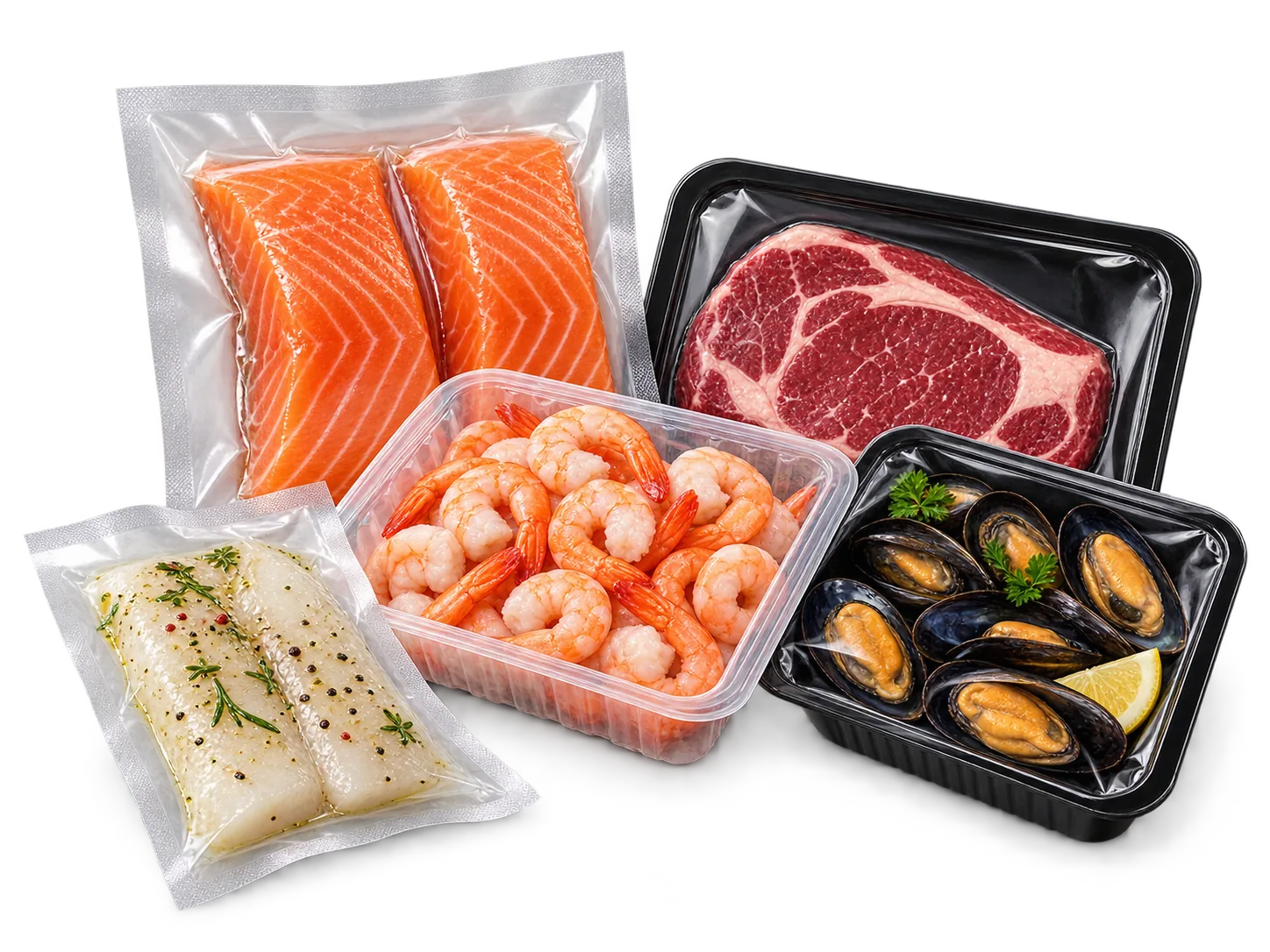
Nylon structures rated for puncture and low temperature
Vacuum, skin-pack and modified-atmosphere formats
Gas mixes specified against the product
Cold-chain labels that stick to a wet, cold surface
What fresh protein does to a pack
Four failures that show up in this category and almost nowhere else.
It punctures the film
Bone ends, shell, fin and frozen edges will breach a thin pack, and vacuum makes it worse by pulling the film hard onto every sharp point. Nylon is what resists it; a PE-only structure is not a vacuum pouch however thick it is.
Shelf life is an oxygen question
For most fresh protein, days of shelf life map almost directly onto residual oxygen. That leads to two answers: pull the air out entirely with a vacuum or skin pack, or replace it with a gas mix that suppresses spoilage — and they are not interchangeable.
Colour is what the shopper judges
Red meat reads as fresh when it is red, which needs oxygen — the opposite of what extends microbial life. A MAP mix for fresh beef trades the two off deliberately: oxygen to hold the bloom, carbon dioxide to slow the bacteria. Fish and cooked product usually take no oxygen at all.
Everything is cold and wet
A label applied to a chilled, damp surface with an ordinary adhesive lifts within a day. A film that goes brittle at freezer temperature cracks at the seal. Both are specification choices, made before the order rather than after the complaint.
Formats for meat and seafood packaging
Vacuum, skin and gas — and the pack each one needs.
Vacuum pouch
Nylon-based, made to have the air drawn out and stay that way. Frozen through ambient, smooth or embossed for chamber machines.
Skin pack tray
Film drawn down over the product itself. No headspace, no drip pooling, and the pack can be displayed vertically.
MAP tray
Air replaced with a gas mix chosen for the product, sealed under anti-fog lidding across the whole rim.
PA / nylon film
The toughness ply itself, for thermoforming your own webs — cast, oriented or coextruded.
PET tray
Glass-clear chilled display where the product sells itself, in APET for sealing to a lidding film.
Thermal label
Weight, batch and use-by printed on the line, with freezer adhesive for cold wet surfaces.
Structures that suit it
PA/PE and PET/NY/PE are the working structures here: nylon for puncture and tear resistance, polyethylene for a seal that closes reliably through moisture. Both hold their properties from freezer temperatures upward, which matters because a film that stiffens below zero cracks where it is flexed. Thickness follows the product — bone-in and shell-on need more than a fillet. The films themselves are in films and rolls, and materials and structures explains what each ply contributes.
What has to be provable
Fresh protein carries the tightest traceability requirements of any category we supply. Beyond food-contact declarations to FDA or GB standards, the pack usually has to carry batch identification, a use-by date and, for export, an establishment number — which makes the label a regulatory component rather than decoration. Cold-chain adhesives have to be declared as food-contact where the label touches the product. See export packaging compliance and quality and compliance.
The rules themselves are public: FDA 21 CFR 177, the US list of permitted food-contact polymers.
Questions we are asked about meat and seafood
Vacuum or MAP for fresh red meat?
MAP if the colour has to read as fresh on a shelf, because that needs oxygen. Vacuum or skin pack if shelf life matters more than bloom — which is usual for primals, food service and export.
Why does my vacuum pouch keep failing at the bone?
Almost always a structure without enough nylon, or too thin for the product. Atmospheric pressure concentrates on every sharp point for the whole life of the pack; thickness alone does not fix it, the nylon ply does.
What gas mix should I use?
It depends on the product. Fresh red meat typically takes high oxygen with carbon dioxide; fish, poultry and cooked product typically take nitrogen and carbon dioxide with no oxygen. Tell us the product and the target shelf life.
Do you supply embossed vacuum pouches?
Yes. Embossed pouches give the air channels a chamber machine needs; smooth pouches suit nozzle and external machines. Which one depends on your equipment.
Will an ordinary label stay on a chilled pack?
Usually not. A freezer or high-tack adhesive is formulated to grip a surface that is already cold and wet at the moment of application, which standard adhesives will not do.
Can a skin pack use a board base?
Yes, and it is increasingly specified — a printed board base with the film drawn over the product gives a recyclable presentation with less plastic than a rigid tray.
Tell us the product, the process and the shelf life
Whether it is bone-in, whether it is frozen, and whether it is vacuum, skin or gas-flushed decide the structure between them. With those, a quotation is a specification.
Key Information
Meat and seafood packaging is set almost entirely by how much oxygen is left against the product. The product is sharp and wet, and vacuum or modified atmosphere packing is usually what extends the shelf life rather than the film alone.
- Shelf life is decided mainly by residual oxygen against the product.
- Vacuum and modified atmosphere packing are the two main processes, and they need different structures.
- Bone and shell puncture film, so nylon or a skin-pack structure is used for protection.
- High-barrier structures for fresh protein typically use EVOH or nylon as the barrier layer.
- Vacuum skin packaging holds the product against the tray and removes headspace entirely.
What is the difference between vacuum and MAP for meat?
Vacuum removes the air and holds the film against the product; modified atmosphere replaces the air with a chosen gas mix. Vacuum suits primal cuts and long chill life; MAP suits retail display where colour matters.
What stops bone puncturing the pack?
A nylon layer or a vacuum skin structure, which is formed to the product rather than sealed around it.
How long does vacuum packing extend shelf life?
It depends on the residual oxygen and the chill chain; the structure sets the ceiling, the process and the storage temperature set the result.