
Frozen food packaging that stays flexible below zero
Cold changes what a film can do. Polymers that are tough at room temperature go brittle in a freezer and crack where they are flexed; adhesives that grip a dry carton slide off a frosted one; and every pack coming out of cold storage sweats as it warms. Frozen food packaging is a materials problem before it is a design one.
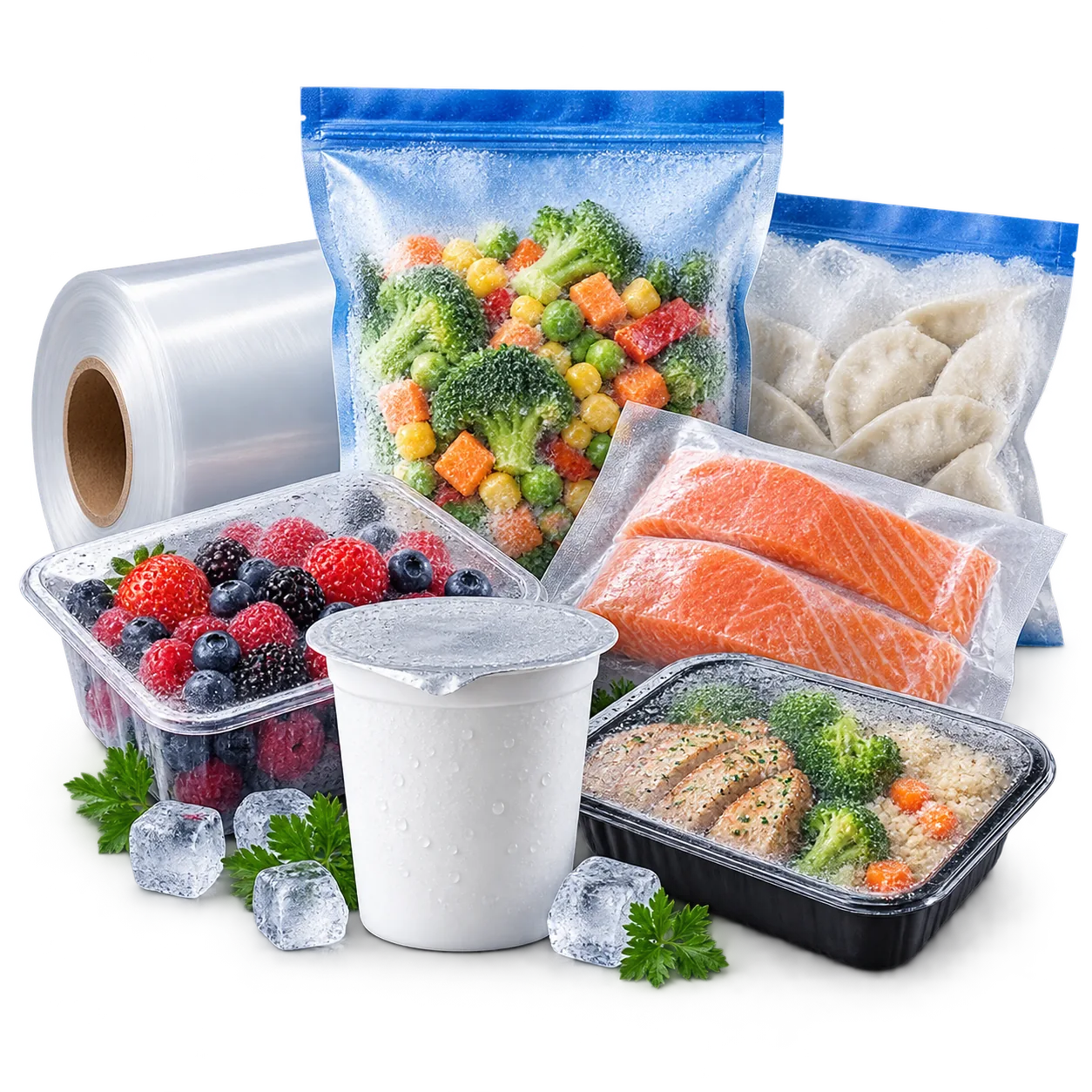
Nylon and PE structures rated from −40 °C
Freezer-grade adhesives for cold, damp surfaces
Anti-fog lidding for chilled display
Structures that survive the freeze–thaw cycle
What cold does to a pack
Four things that are fine at 20 °C and not at −20 °C.
Films go brittle and crack
Below its glass transition temperature a polymer stops bending and starts breaking. PE and nylon stay flexible well below zero; several otherwise excellent films do not, and they fail at the seal or the fold rather than in the middle of a panel.
Adhesives will not grip
A standard label adhesive needs a dry surface at room temperature to wet out and bond. Applied to a frosted pack it tacks, then lifts within hours. A freezer adhesive is formulated to bond at the moment of application on a cold, damp surface.
Condensation forms on the way out
A pack leaving cold storage collects moisture from warmer air, which softens board, lifts labels and fogs a clear lid so the product disappears. Anti-fog coatings and coated board are the answers, and both are specified rather than assumed.
Freeze–thaw is repeated, not single
Product that is frozen, part-thawed in transit and refrozen stresses a pack far more than a single freeze. The structure has to survive the cycle, which is a thickness and materials question, not a matter of the pack looking intact on arrival.
Formats for frozen food packaging
What frozen and chilled ranges actually ship in.
Vacuum pouch
Nylon-based and rated frozen to ambient, with excellent vacuum retention for protein and prepared foods.
Zipper pouch
Resealable frozen packs — vegetables, fruit, portions — in PA/PE for low-temperature performance.
PE film
The sealing layer that stays flexible in a freezer, in LDPE and LLDPE, made to your web width.
CPET tray
Freezer to conventional oven in the same tray, −40 °C to 220 °C, for frozen ready meals.
MAP tray
Chilled ranges with a gas mix and anti-fog lidding, so the product is visible after an hour in a cabinet.
Synthetic paper label
A waterproof, tear-resistant facestock with a freezer adhesive that bonds to a cold wet pack.
Structures that suit it
PA/PE is the reference structure for frozen flexible packaging: nylon keeps its toughness at low temperature and polyethylene keeps sealing. For chilled rather than frozen, APET and PP trays with a sealable rim cover most of the category. Paper-based structures need a coating chosen for condensation rather than for grease. Our nylon film and PE film pages set out what each ply does, and how to choose flexible packaging materials works through the whole decision.
What has to be provable
Frozen and chilled foods are food-contact products, so FDA or GB declarations apply as they do elsewhere. What is specific here is the date marking: a use-by or best-before that has to remain legible after frost, condensation and handling, which in practice means the label substrate and the printing method are part of the compliance answer rather than separate from it. Where a cold chain is claimed, the documentation usually has to show it was maintained. See export packaging compliance.
The rules themselves are public: FDA 21 CFR 177, the US list of permitted food-contact polymers.
Questions we are asked about frozen and chilled food
Why do my frozen bags split at the seal?
Usually a sealant that is not rated for the temperature, or a structure with no nylon ply. Both become obvious at −18 °C and neither shows up in a room-temperature drop test.
Do I need a special adhesive for freezer labels?
Yes, if the label is applied to product that is already cold. If it is applied before freezing, a standard permanent adhesive usually holds.
What is anti-fog and do I need it?
A coating on the inside of a clear film or lid that stops condensation forming droplets. If the pack is displayed chilled and the product is meant to be seen, it is worth specifying — without it the pack fogs within minutes of leaving a cabinet.
Can one pack go from freezer to oven?
In a rigid tray, yes — CPET and aluminium foil both do. In a flexible pack, only a structure specified for it; most frozen pouches are not ovenable.
Does freezing reduce the barrier I need?
It reduces the rate of spoilage, not the need for a barrier. Freezer burn is moisture loss through the pack, so moisture barrier still matters — often more, because the shelf life is longer.
What thickness should a frozen vegetable bag be?
It depends on the fill weight and whether the bag is handled cold. Send both and we will specify rather than guess.
Send the temperature range, not just the product
Chilled, frozen, or frozen and reheated in the pack are three different specifications. Tell us which, and whether the label goes on cold, and the structure follows.
Key Information
Frozen food packaging has to stay flexible below zero. Polymers that are tough at room temperature go brittle in a freezer and crack where they are flexed, and adhesives that grip a dry carton slide off a frosted one.
- Films that are tough at room temperature can go brittle below zero, so cold-flex performance is specified rather than assumed.
- Polyethylene and nylon are commonly used because they retain flexibility at freezer temperatures.
- Seal integrity has to survive handling while frozen, not only at filling.
- Labels and adhesives need a freezer-grade specification.
- Frost on the pack surface affects both adhesion and print legibility.
Why do frozen packs crack?
Because the film chosen for room-temperature toughness becomes brittle below zero. A frozen specification names cold-flex performance, usually met with polyethylene and nylon.
Do frozen packs need a high oxygen barrier?
Less than ambient packs, because freezing slows oxidation — but freezer burn is a moisture problem, so the water vapour barrier still matters.
What about labels on frozen packaging?
They need a freezer-grade adhesive. A standard adhesive releases on a frosted surface.