Film structure explained, layer by layer: PET/NY/AL/PE is not a product code, it is the pack written outside-in, and once you can read those 4 letters you can tell what a pack will do.
Every packaging quotation carries a string like PET/AL/PE or PET/NY/CPP, and it is the most information-dense thing on the page. It is not a product code. It is the structure written out layer by layer, from the outside of the pack inward, and once you can read it you can tell what a pack will and will not do without asking.
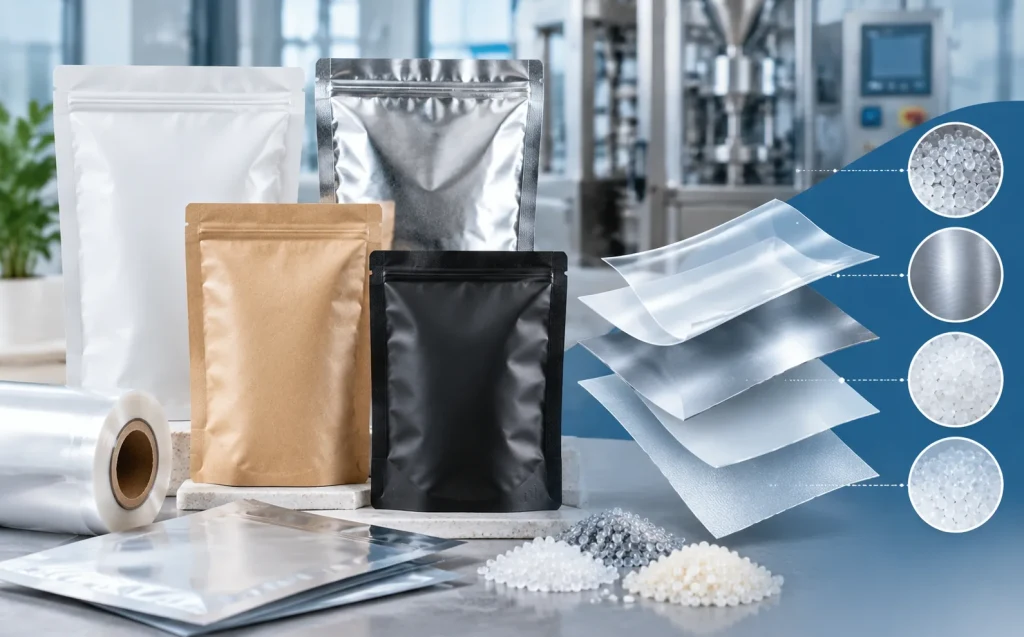
Outside in, always
The first named layer faces the world; the last touches the product. PET/AL/PE is polyester outside, aluminium foil in the middle, polyethylene against the food. That order is a convention and it holds everywhere — so PET/PE and PE/PET would be two different packs, and only one of them makes sense.
What each layer is for
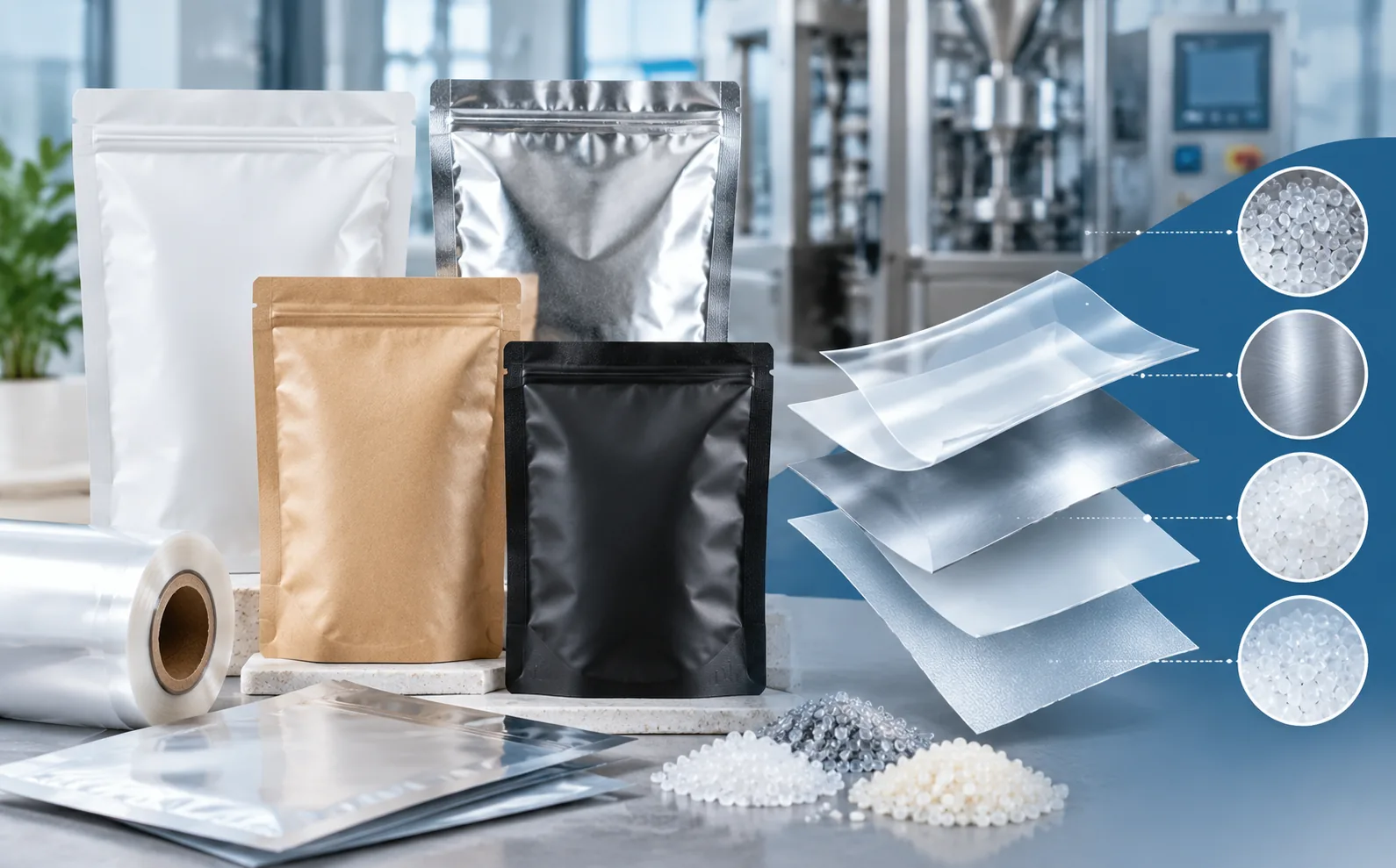
Layers are chosen because each does something the others cannot. A laminate exists precisely because no single polymer does everything.
- PET (polyester) — the structural and print layer. Dimensionally stable, so the artwork stays in register through printing and lamination, and tolerant of heat. Does not seal to itself. See PET film.
- BOPP — an alternative outer: stiffer and glossier than PET, excellent print reproduction, lower cost, less heat tolerance. See BOPP film.
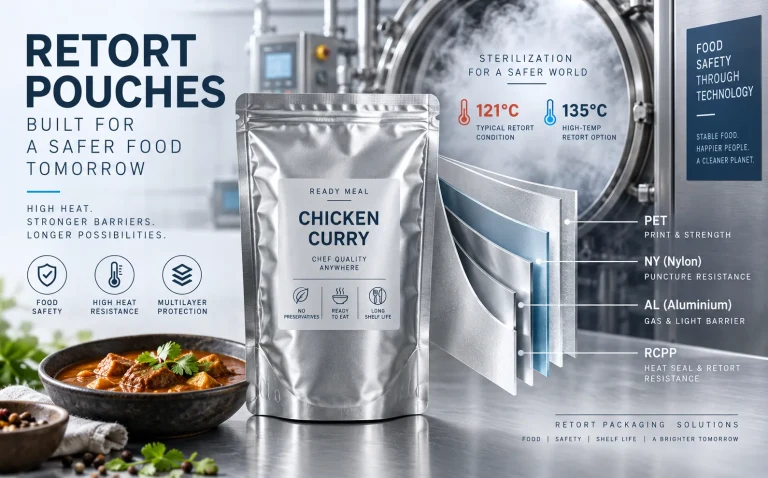
- NY or PA (nylon) — the toughness layer. Puncture and tear resistance, oil resistance, and it keeps working from freezer temperatures through a retort cycle. See nylon film.
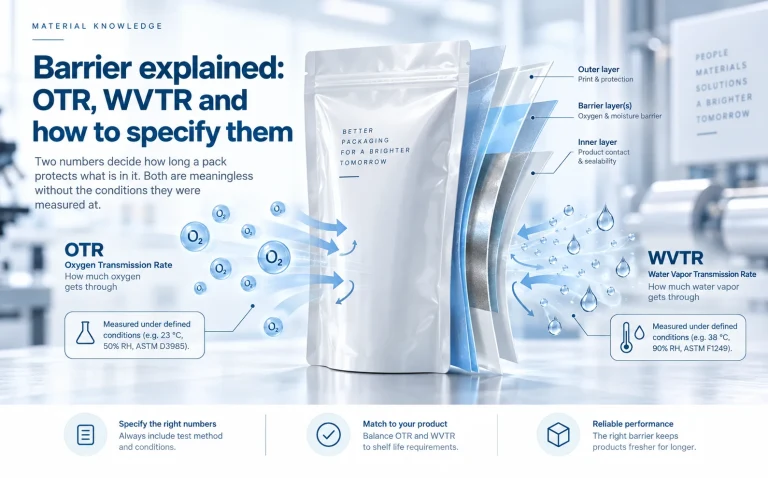
- AL (aluminium foil) — a complete barrier to light, oxygen and moisture, and the only flexible material that is. Adds weight and cost, creases permanently. See aluminium foil film.
- VMPET (metallised PET) — a nanometre-thin aluminium coating on PET. Near-foil barrier at a fraction of the weight and cost, but it can pinhole under hard flexing and is not a retort material. See metallized PET film.
- PE (polyethylene) — the usual sealant. Seals at low temperature, stays flexible when cold, no real barrier of its own. See PE film.
- CPP (cast polypropylene) — the sealant when PE cannot take the heat: hot fill, and retort in the right grade. See CPP film.
Reading four real structures
PET/PE — print layer and sealant, nothing else. Cheap, clear, low barrier. Right for dry goods that turn over in weeks; wrong for coffee.
PET/VMPET/PE — print, metallised barrier, sealant. High barrier without foil’s weight. This is most of the coffee and snack market.
PET/AL/PE — print, complete barrier, sealant. Long shelf life, opaque, heavier. Pharmaceuticals, premium coffee, anything measured in years.
PET/NY/AL/PE — print, toughness, complete barrier, sealant. The four-layer retort structure: nylon survives sterilisation and handling, foil gives the two-year ambient life.
What the string does not tell you
Thickness. PET/AL/PE says nothing about whether the foil is 7 microns or 12, and that is a large difference in both barrier and cost. Micron figures per layer are part of a real specification and should appear on any quotation you are comparing.
It also says nothing about the adhesive between the layers, which is where food-contact compliance and fat resistance are frequently decided — and nothing about seal initiation temperature, which is what determines whether the film runs on your line. Our page on materials and structures sets out what to ask for, and laminate versus mono-material structures covers what all this costs in recyclability.
The standards behind this are public: see FDA 21 CFR 177, which lists the permitted polymers.
Film structure explained in short
- The string is written outside-in: the first layer faces the world, the last touches the product.
- PET is structure and print, nylon is toughness, foil and metallised PET are barrier, PE and CPP are the seal.
- A laminate exists because no single polymer does all four jobs.
- The string does not tell you thickness per layer or which adhesive is between them, and both belong on a quotation.
Key Information
A film structure such as PET/NY/AL/PE is not a product code: it is the pack written outside-in, one layer at a time. Reading it tells you what the pack will do before any specification sheet is opened.
- Layers are always written outside-in, so the first letter is the printed outer surface and the last is the layer that touches the food.
- PET gives print quality and dimensional stability; NY (nylon) gives puncture and flex resistance; AL (aluminium foil) gives the barrier; PE and CPP are sealant layers.
- A structure string does not state thickness, and two packs with the same string can perform very differently.
- A structure string does not state the adhesive or the printing method.
- The sealant layer is what determines whether a pack can be retorted.
What does PET/AL/PE mean?
Three layers, written outside-in: a PET outer that carries the print, an aluminium foil middle that provides the barrier, and a polyethylene inner that seals against itself and touches the product.
Why do some structures include nylon?
Nylon adds puncture and flex resistance, which matters for a pack that is handled roughly, frozen, or filled with something sharp such as coffee beans or pet food.
Is a longer structure always better?
No. Each layer adds cost, thickness and recycling difficulty. The right structure is the shortest one that meets the barrier and the process.