Mono-material structures and laminates are 2 answers to the same question, and the trade is honest in both directions: a laminate protects better, a mono-material recycles better.
Every flexible pack is a compromise between protection and recyclability, and for thirty years protection won without much argument. That has changed — packaging regulations, retailer commitments and buyers’ own targets have made recyclability a specification rather than a preference. Understanding what you actually lose is the difference between a considered decision and a marketing one.
How a laminate works
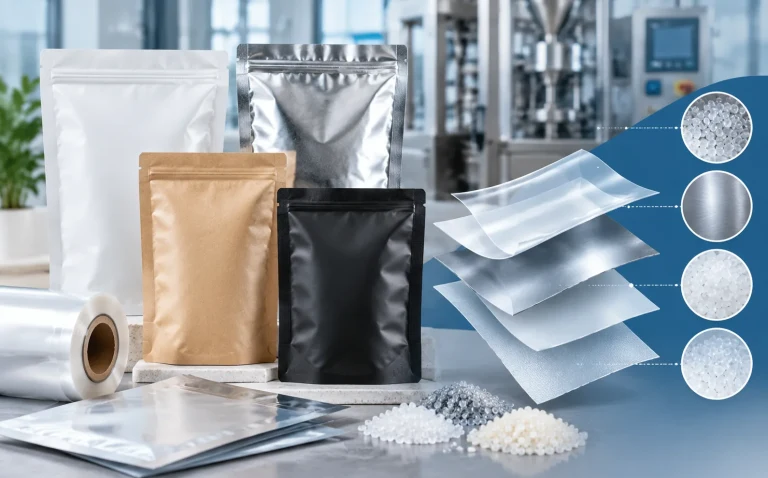
A laminate is two or more films bonded together, each doing one job the others cannot.
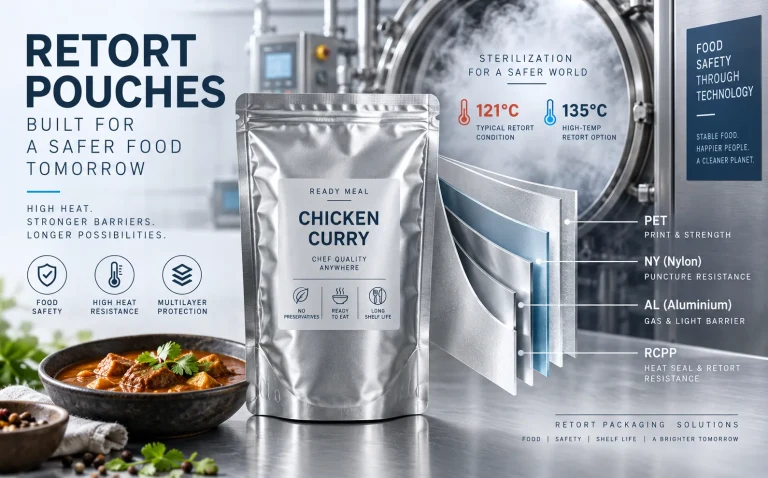
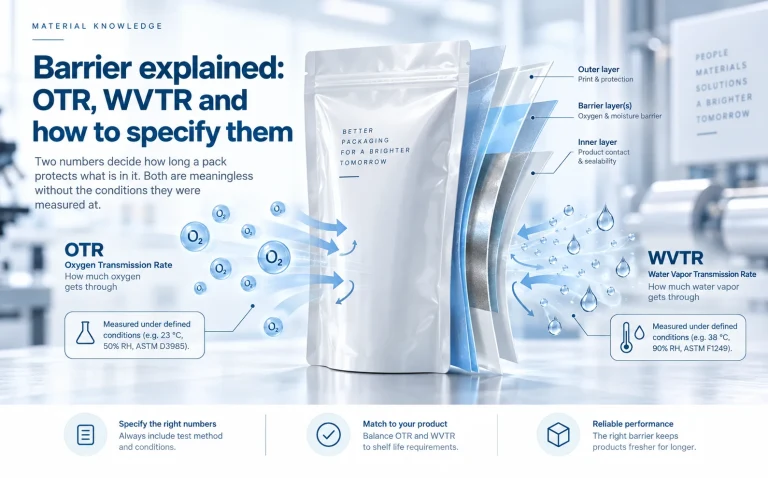
In PET/AL/PE the PET on the outside carries the print and gives the pack its stiffness and scuff resistance. The aluminium foil in the middle is the barrier — it stops light, oxygen and moisture almost completely. The PE on the inside is the sealant, the layer that melts against itself to close the pack.
Swap the foil for metallised PET and you get PET/VMPET/PE: nearly the same barrier at less cost and less weight, still opaque, still not recyclable in a normal stream. Swap it for nylon and you get PET/NY/PE, which survives retort at 121 °C.
The strength of the approach is exactly its problem. Different polymers bonded together cannot be separated at a recycling plant, so the pack is sorted out as residue.
How a mono-material works
A mono-material pack uses one polymer family throughout — commonly all polyethylene, PE/PE. The outer layer is a stiffer, oriented PE that takes print; the inner is a sealant PE. Because both are polyethylene, the pack goes into an existing PE recycling stream.
The barrier comes from the polymer itself plus, where needed, a coating. It is good, not excellent. On the catalogue’s scale a mono-PE structure earns a solid middle rating for moisture and a weaker one for oxygen than any metallised laminate.
There is a second family worth knowing: PLA/PBAT, which is compostable rather than recyclable. Different disposal route, different infrastructure, and worth checking that the route actually exists in your market before you print a claim about it.
What you give up, honestly
Oxygen barrier is the real loss. If your product is sensitive to oxygen — coffee, nuts, fish oil, anything with fat that goes rancid — a mono-material will shorten its shelf life, and no amount of specification writing changes that.
Heat resistance is the second. Mono-PE softens where a laminate holds, so hot-fill and retort are out.
Stiffness is third and it is more practical than it sounds. Mono-material films are floppier, which affects how a pouch stands on a shelf and how it behaves on a filling line running at speed.
Where each one belongs
Mono-material suits frozen food, household goods, dry retail products, and anything with a short turnover and a moderate barrier need. Frozen is a good fit because the cold does the preserving.
A laminate remains the answer for coffee, ground spices, powdered nutrition, pharmaceuticals, wet pet food and anything going through a retort. Recyclability claims on those products usually collapse under a shelf-life test.
There is a middle position worth considering: a paper-faced structure such as kraft paper/VMPET/PE. It reads as natural, carries a real barrier, and shifts a good part of the pack’s weight to a renewable material — but it is still a laminate, and still not recyclable in a paper stream.
How to decide
Start with the shelf life you need and the oxygen sensitivity of the product. If a mono-material meets both, take it — there is no reason not to.
If it does not, be specific about the gap before you accept a shorter shelf life. Two months less on a product that sits in distribution for three is a returns problem, not a sustainability win.
And test it. We supply samples in both structures so the comparison is made on your product, in your conditions, rather than on a datasheet.
The standards behind this are public: see the Ellison guidance on recyclability claims published by the FTC.
Laminates and mono-materials in short
- A laminate stacks different films so each layer does one job, and that is why it protects better.
- A mono-material uses one polymer so a recycling stream can take it, and that is why it protects less.
- The gap is barrier: no mono-material reaches a foil laminate, and pretending otherwise costs shelf life.
- A recyclability claim has to hold where the pack is thrown away, not where it is filled.
Key Information
Laminates and mono-material structures are two answers to the same question, and the trade is honest in both directions: a laminate protects better, a mono-material recycles better.
- A laminate combines different polymers so each layer does one job; that is why it protects well and why it cannot be recycled in a standard stream.
- A mono-material pack is built from one polymer family, most often all-PE or all-PP, so it can enter an existing recycling stream.
- Mono-material structures generally give up some barrier and some heat resistance.
- Recyclability depends on the collection stream available in the destination market, not only on the structure.
- The right choice is set by the product's shelf life and the market's waste infrastructure together.
Is mono-material packaging as good as a laminate?
Not for barrier or heat resistance. It is better for recyclability. Which matters more depends on the product's shelf life and the market the pack is sold into.
Can a mono-material pouch be retorted?
Generally no. Retort at 121 °C needs a structure built for it, which in practice means a laminate with a suitable sealant.
Does a mono-material pack actually get recycled?
Only where a collection stream exists for that polymer. The structure makes it possible; the destination market's infrastructure decides whether it happens.