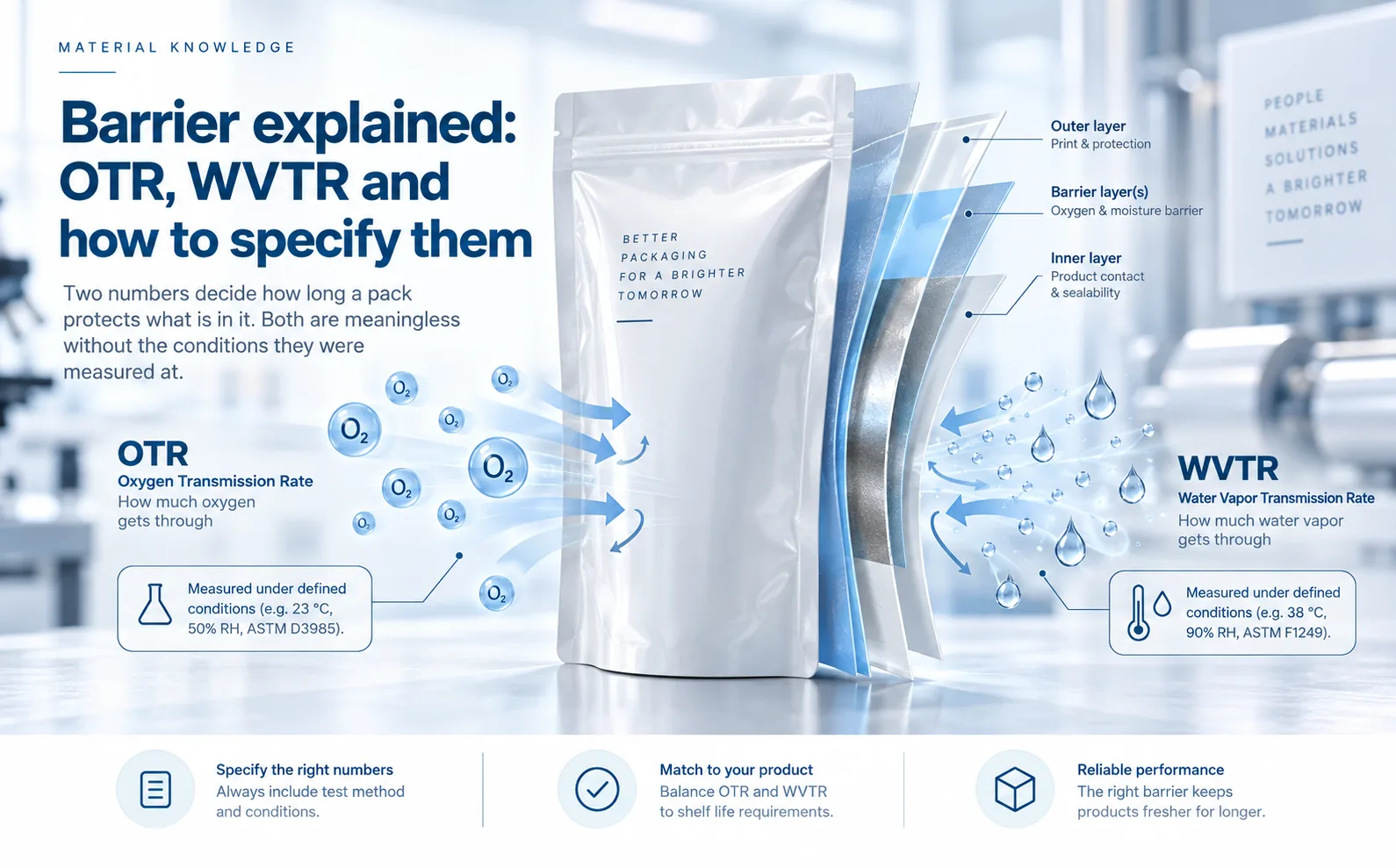
OTR and WVTR are the 2 numbers that decide how long a pack protects what is in it, and both are meaningless without the temperature and humidity they were measured at.
Barrier is the property a packaging buyer pays most for and specifies least precisely. “High barrier” appears on a great many quotations and means nothing on its own. The two numbers that do mean something are OTR and WVTR, and both come with conditions attached that matter as much as the figure.
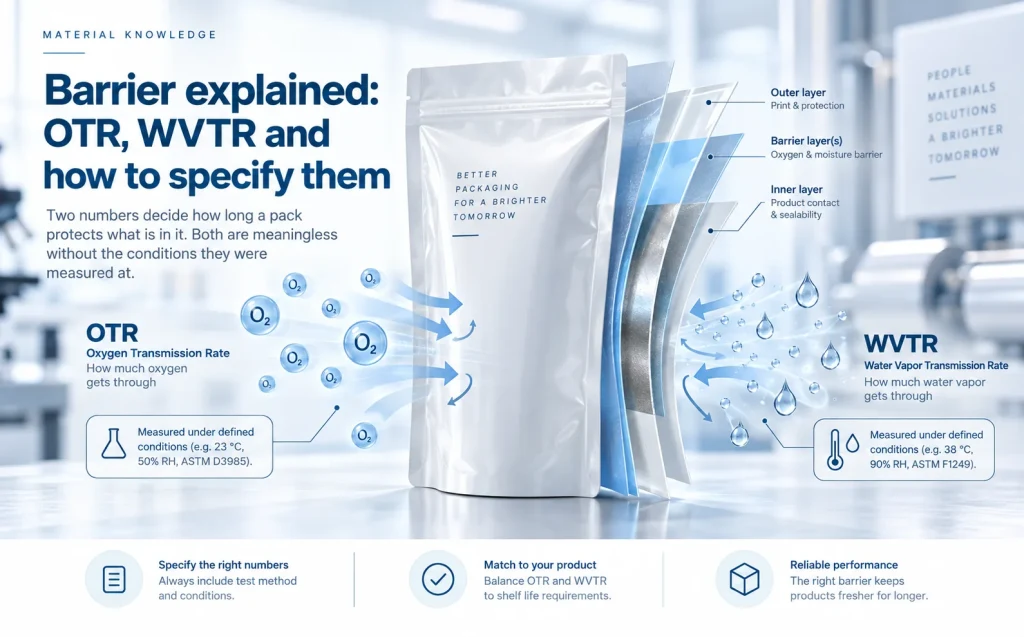
OTR — oxygen transmission rate
How much oxygen passes through a square metre of the material in a day. Quoted as cc/m²/day, sometimes written cm³/m²/24h. Lower is better.
It matters for anything that oxidises: coffee oils, nuts, fats, vitamins, wine, and the colour of red meat. Rough bands, at 23 °C and 50 per cent relative humidity: above 100 is effectively no barrier, which describes plain PE. Between 10 and 100 is a modest barrier — PET/PE sits here. Between 1 and 10 is good, which is where nylon and coated films land. Below 1 is high barrier: metallised PET and foil structures. Aluminium foil in an intact laminate is effectively zero.
WVTR — water vapour transmission rate
How much water vapour passes through, in g/m²/day. Lower is better. It matters for anything that goes soft, cakes, or has to stay dry: crisps, biscuits, powders, effervescent tablets, and anything with a desiccant in it.
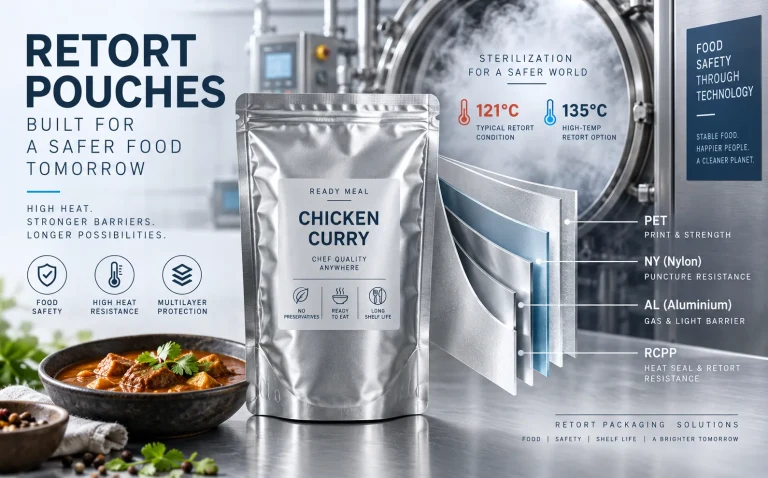
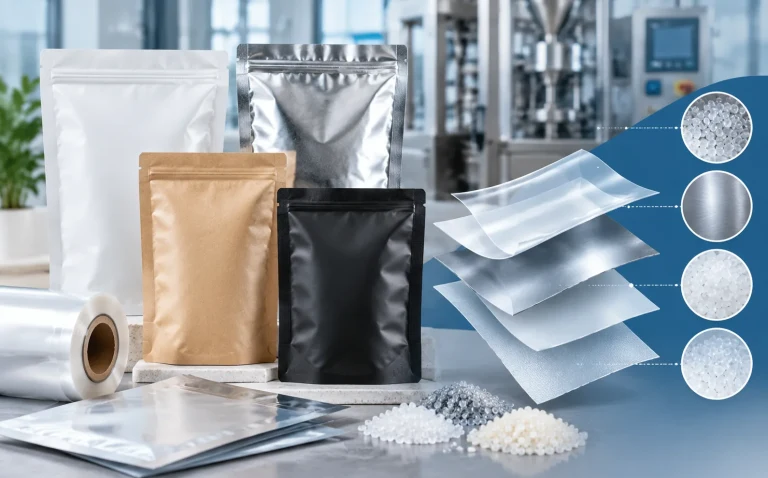
A pack can be excellent at one and poor at the other. Nylon is a good oxygen barrier and a mediocre moisture barrier, because it absorbs water. Polypropylene is the reverse. This is exactly why laminates exist, and why asking for “high barrier” without saying which one is asking for a guess.
The conditions are part of the number
OTR and WVTR are measured at a stated temperature and humidity, and both figures move sharply with both. A nylon structure quoted at 50 per cent relative humidity can be several times worse at 90 per cent, because the nylon has taken up water. A film quoted at 23 °C behaves differently in a container crossing the tropics.
So a barrier figure without its conditions is not a specification. Ask for the temperature and the relative humidity, and make sure two quotations you are comparing were measured the same way — otherwise the cheaper film may be the better one and you cannot tell.
From shelf life to a number
Working backwards is the useful direction. You need three things: how much oxygen or moisture your product can take up before it fails, the surface area of the pack, and the shelf life you want. The permissible gain divided by the shelf life and the area gives the transmission rate you need.
In practice most buyers do not have the first figure, which is fine — it comes from shelf-life testing, and testing an existing pack that works is usually quicker than deriving it. What matters is not pretending a number exists when it does not. See quality and compliance for what we test.
What to ask for
Name the product and what it is sensitive to, the shelf life, and the climate it is sold into. That is enough for us to propose a structure and quote its OTR and WVTR at stated conditions, which you can then compare properly against anything else on your desk.
The structures themselves are set out in materials and structures, and how to read a film structure explains which layer is doing the barrier work.
The standards behind this are public: see ASTM, which publishes the test methods these figures are measured by.
OTR and WVTR in short
- OTR is oxygen through a square metre a day; WVTR is water vapour. Lower is better for both.
- A pack can be excellent at one and poor at the other, which is why laminates exist.
- Both figures move sharply with temperature and humidity, so a number without its conditions is not a specification.
- Work backwards: what the product can take up, divided by shelf life and pack area, gives the rate you need.
Key Information
OTR (oxygen transmission rate) and WVTR (water vapour transmission rate) are the two numbers that decide how long a flexible pack protects its contents. Neither number means anything without the temperature and humidity it was measured at, which is why "high barrier" on a quotation is not a specification.
- OTR is measured in cc/m²/day, WVTR in g/m²/day; a lower number is a better barrier.
- OTR is normally quoted at 23 °C and 0% relative humidity; WVTR at 38 °C and 90% relative humidity.
- A quoted barrier figure without its test conditions cannot be compared against another supplier's figure.
- Aluminium foil laminates reach an OTR below 0.1 cc/m²/day; clear PET/PE structures sit in the tens.
- Shelf life is derived from the barrier figure, the headspace and the product, not from the film alone.
What is a good OTR for coffee packaging?
Roasted coffee needs an OTR below about 1 cc/m²/day to hold aroma for a year, which in practice means a foil or metallised laminate rather than a clear structure.
Why do two suppliers quote different barrier figures for the same film?
Because they measured at different temperature and humidity. WVTR at 38 °C and 90% RH is a much harsher test than at 23 °C and 50% RH, so the same film returns a worse-looking number under the honest condition.
Does a higher barrier always mean a longer shelf life?
No. Barrier is one input; the product's own sensitivity, the headspace oxygen left at filling, and the storage temperature set the rest.