
Pet food packaging built for fat, weight and teeth
Pet food packaging fails in ways human food packaging does not. The fat content attacks the laminate from the inside, the pack weighs several kilos and is dragged off a shelf by a handle, kibble abrades the seal, and wet food is sterilised in the pouch at 121 °C. The structure has to be specified for all of it.
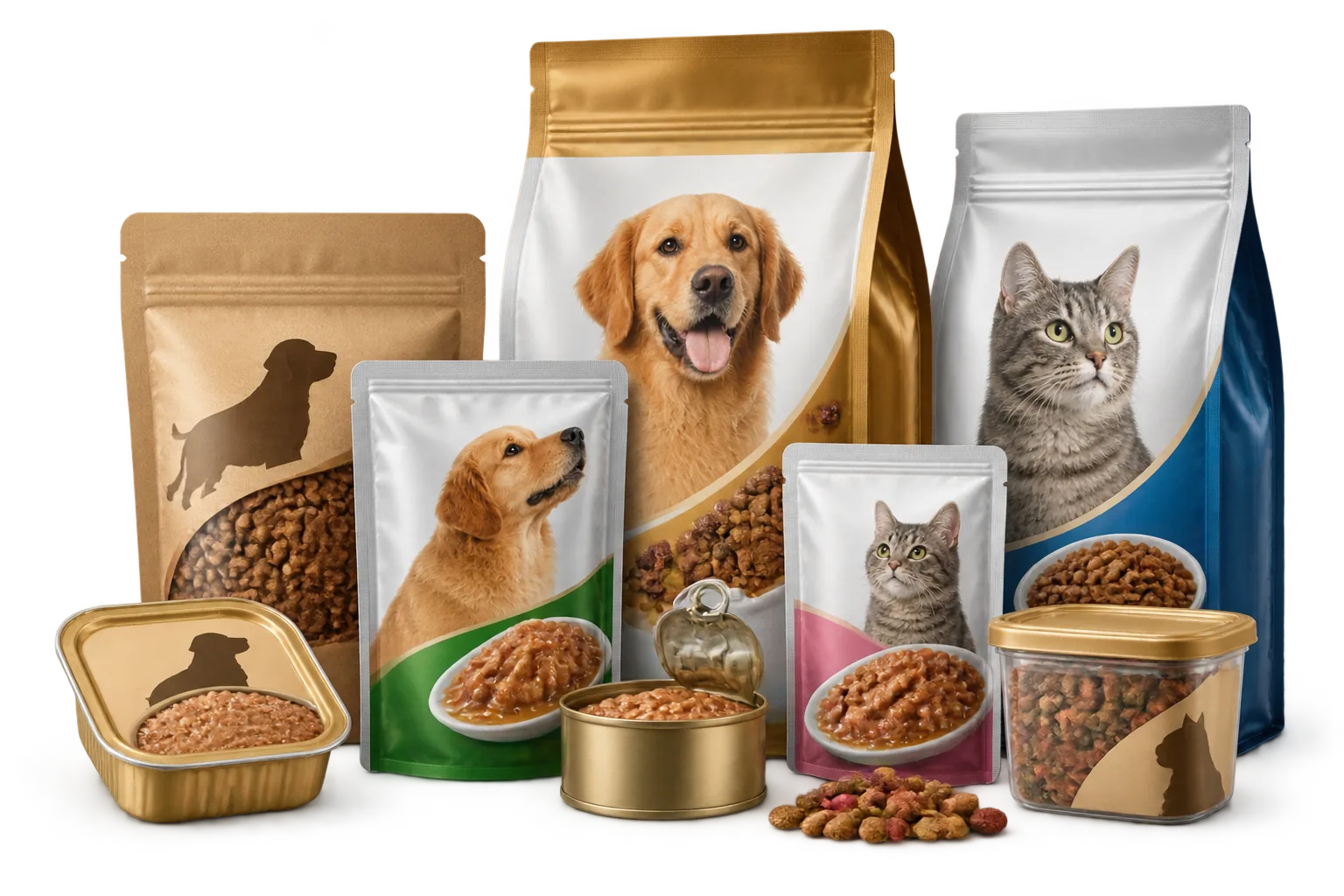
Heavy-duty structures for 1 kg to 15 kg fills
Retortable pouches for wet and semi-moist food
Resealable zips that survive repeated opening
Grease-resistant laminates that hold their seal
What pet food does to a pack
Four things that separate a pet food pouch from a snack bag.
Fat migrates into the laminate
The oils in dry kibble and treats work into a laminate over months and weaken the bond between layers, which shows up as delamination and seal failure near the end of shelf life. Nylon and the right adhesive system resist it; a cheap two-ply structure does not.
The pack is heavy and handled roughly
A 10 kg bag is carried by its top seal, dropped onto a pallet and dragged along a shelf. Thickness, seal width and gusset design all follow from the fill weight, which is why we ask for it before quoting anything.
Kibble abrades from the inside
Dry pet food is hard and angular, and it works against the inner ply every time the bag is moved. A sealant layer chosen for slip and puncture resistance rather than for seal strength alone is what stops a pinhole becoming a split.
Wet food is cooked in the pack
Wet and semi-moist food is filled and then retorted at 121 °C, which almost nothing survives. That is a PET/NY/AL/PE structure and a seal specification, not a choice of bag.
Formats for pet food packaging
Dry, wet, treats and single portions each land on a different format.
Stand-up pouch
The standard dry food and treat pack, available with a gusseted base that carries weight and a zip for reclosure. Structures to 15 kg.
Retort pouch
For wet food sterilised in the pack. Shelf stable without refrigeration, in flat, stand-up or spouted form.
Zipper pouch
Treats and smaller dry packs that are opened daily. The press-to-close zip protects what is left, which is most of the bag.
Spout pouch
Semi-moist and pourable food, and for liquid supplements. The spout meters a portion and recloses.
Back seal pouch
Formed on the line from roll stock for high-volume single-portion packs and sample sachets.
Heavy-duty carton
For bulk and export shipments of bagged food, where the outer has to survive stacking and a long route.
Structures that suit it
Dry food with a fat content above about ten per cent wants a nylon ply — PET/NY/PE or PET/NY/AL/PE — because nylon resists both the fat and the puncture that kibble causes. Metallised structures suit treats and premium ranges where light protection matters for the oils. Wet food is retort only. Where a brand needs a recyclable claim, a mono-material PE structure is possible at a lower barrier; laminate versus mono-material structures sets out what that costs. The full range is in flexible pouches.
What has to be provable
Pet food packaging is regulated as food-contact material in most markets even though the food is not for people, so the same FDA and GB declarations apply and the same documentation travels with the shipment. Labelling requirements differ from human food and differ again by market — feeding guidance, analytical constituents and additive declarations are usually mandatory. We supply the material declarations; the label content is the brand’s to confirm against the destination market. See export packaging compliance.
The rules themselves are public: FDA 21 CFR 177, the US list of permitted food-contact polymers.
Questions we are asked about pet food
What thickness do I need for a 10 kg bag?
It depends on the structure, not only the weight — a nylon-containing laminate carries more at less thickness than a simple PET/PE. Send the fill weight, the food type and whether the bag has a handle, and we will specify it.
Can a pet food pouch have a handle?
Yes. Die-cut handles, punched hang holes and welded carry handles are all possible, and the reinforcement they need is part of the structure specification rather than an addition to it.
Is a zip worth it on a large bag?
On dry food, usually. Most of a large bag is consumed after the first opening, so the closure protects more product than the original seal does.
Do you supply for wet food that is retorted?
Yes — PET/NY/AL/PE structures rated for 121 °C sterilisation, in flat, stand-up and spouted formats. Seal width and fill level are specified with the structure.
Can pet food packaging be recyclable?
A mono-material PE structure can be, where the collection stream accepts it. It carries a lower barrier than a laminate, so shelf life has to be re-checked against it rather than assumed.
What is the lead time?
It depends on the structure and whether printing cylinders already exist. A repeat order on existing artwork is considerably faster than a first run — ask for both when you request a quote.
Tell us the food, the weight and the shelf life
Fat content, kibble hardness, fill weight and whether the pack is retorted are what decide the structure. With those four, a quotation is a specification rather than an estimate.
Key Information
Pet food packaging fails in ways human food packaging does not: the fat content attacks the laminate from the inside, the pack weighs several kilos and is carried by a handle, and kibble abrades the seal.
- Fat migration attacks the laminate from the inside, so the sealant is chosen for fat resistance.
- Large packs are carried by a handle, which puts load on the seal and the film's tear strength.
- Kibble abrades seals, so nylon is commonly used for puncture and flex resistance.
- Pack weights commonly run from 1 kg to 15 kg.
- A resealable closure is expected on large-format retail packs.
Why does pet food need a different laminate?
Because fat migrates into the film and weakens it from the inside, and kibble abrades the seal. Nylon and a fat-resistant sealant address both.
What format suits a 10 kg pet food pack?
A block-bottom or stand-up pouch with a reinforced handle and a resealable closure, built on a laminate with enough tear strength for the weight.
Does pet food packaging need a high oxygen barrier?
It needs enough to stop fat oxidation, which is what turns food rancid. The shelf life target converts into the OTR figure.