Coffee bag packaging has to solve 3 problems at once: the beans outgas for days, the aroma escapes through ordinary film, and the oils oxidise in light. A bag that solves 2 of them still fails.
Coffee punishes a bad pack faster than almost anything else. Roasted beans release carbon dioxide for days after roasting, so a sealed bag inflates. At the same time oxygen coming the other way strips the aroma that the customer paid for. A pack has to let one gas out without letting the other in.
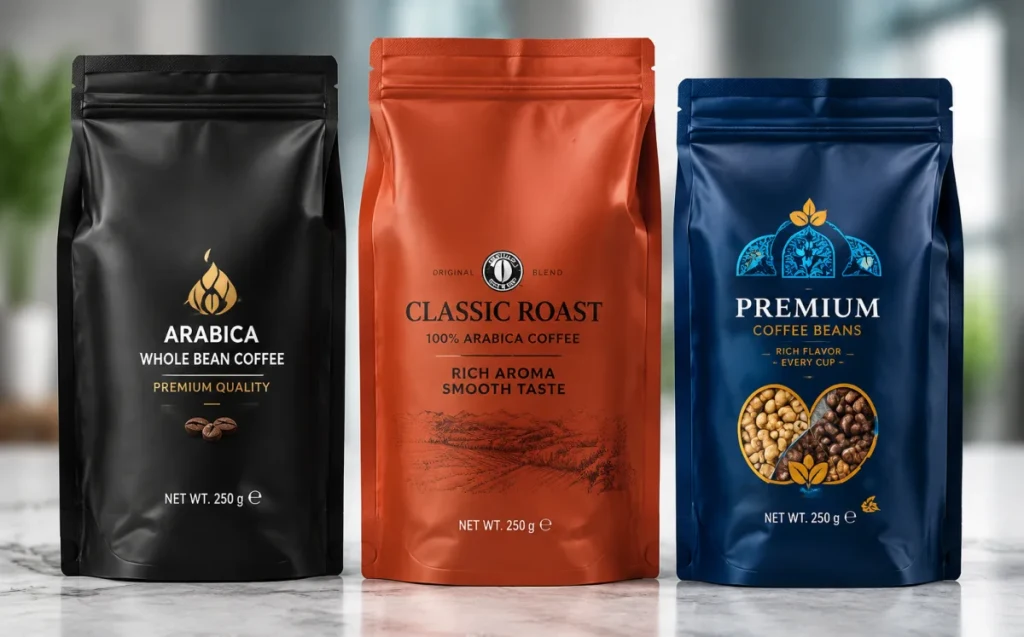
The valve is not optional
A one-way degassing valve vents the CO2 the roast produces while staying shut against oxygen. Without one you have two choices, and both are bad: bag the coffee days after roasting and lose the freshness you were selling, or seal it fresh and accept split seams and ballooned bags in transit.
The valve is fitted to the film during converting, not added afterwards, so it has to be specified at the order. It sits on the face or the gusset depending on the format.
Barrier: what actually keeps the aroma
Oxygen barrier is the number that matters. Whole bean tolerates more than ground; ground coffee has vastly more surface area and stales in weeks.
PET/VMPET/PE reaches the top of the barrier scale with a metallised layer, keeps a good print surface, and stays lighter and more flexible than foil. PET/AL/PE adds a true aluminium layer and is as close to a complete barrier as a flexible pack gets — the choice for long shelf life or hot climates.
A plain PET/PE bag has no business holding coffee beyond a few weeks, whatever it looks like.
Format: flat bottom, stand-up, or side gusset
A flat-bottom bag stands square on a shelf, takes print on five panels, and reads as the premium option. It is what most specialty roasters use.
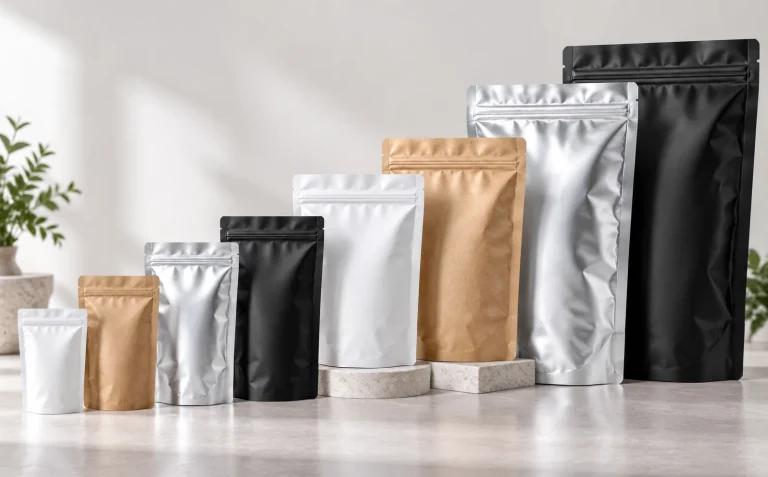
A stand-up pouch is cheaper, holds less rigidly, and works well up to about 500 g. A side-gusset bag is the traditional coffee shape, efficient to fill and ship, and still the standard for larger wholesale weights.
All three are available with a zipper. For whole bean sold to a household, a zipper is worth the cost; for a 1 kg bag going to a café that decants it on day one, it is not.
Finish and print
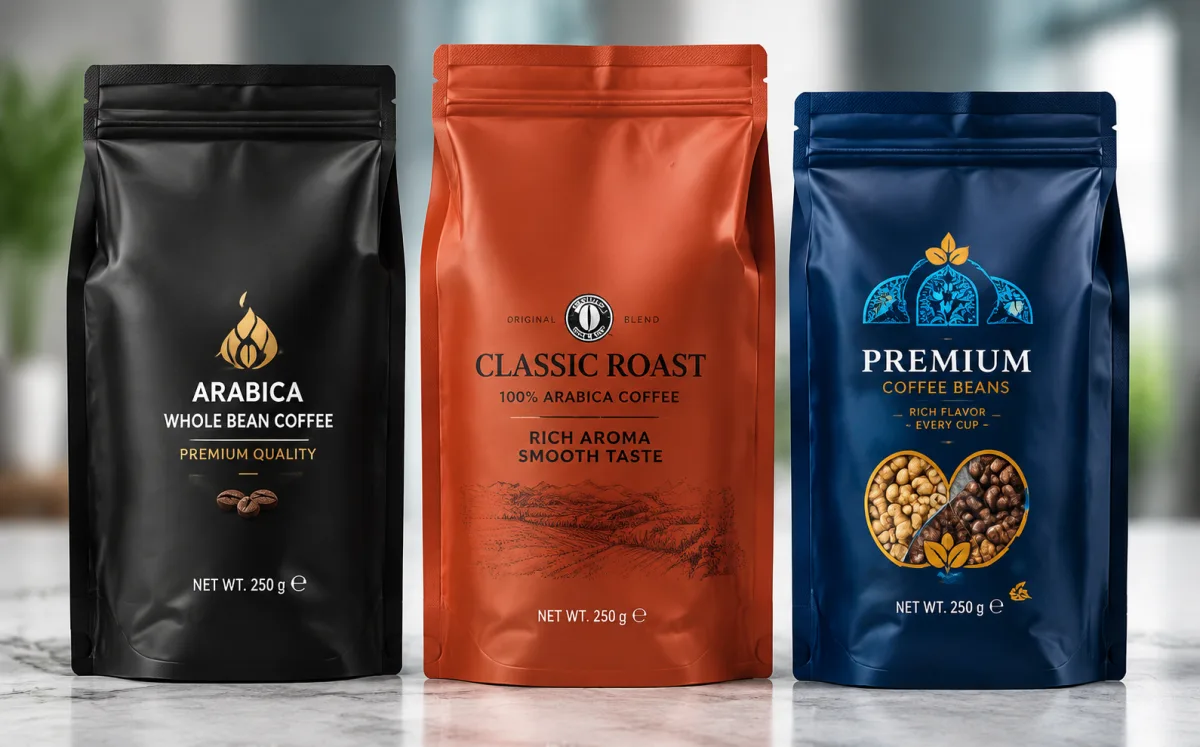
Matt is the default in specialty coffee, and for a reason: it holds a fingerprint less, photographs well, and reads as considered. Gloss makes colour brighter and suits mass-market shelf competition.
Kraft-look structures give the natural, small-roaster look. They print softer — expect less saturation than the same artwork on white PET, and proof the artwork on the actual substrate before signing it off.
Spot UV over matt, and hot stamping in gold or copper, are both common on coffee and both add a plate or foil cost that only makes sense above a certain run length.
A specification that works
For a 250 g specialty whole-bean bag with twelve months of shelf life: flat-bottom format, PET/VMPET/PE structure, matt finish, one-way degassing valve, zipper, tin-tie optional.
For a 1 kg wholesale bag: side gusset, PET/AL/PE if it is stored warm, gloss or matt to taste, valve, no zipper.
For ground coffee at any weight, move up the barrier scale rather than down. Ground stales faster than anything else on this page.
The standards behind this are public: see FDA 21 CFR 177, for the food-contact films a coffee structure uses.
Coffee bag packaging in short
- Roasted beans outgas for days, so a one-way degassing valve is not optional; it is fitted during conversion.
- Aroma passes through ordinary polyethylene, so holding it needs an aluminium or metallised layer.
- Light and oxygen stale the oils, which is what a 5-of-5 barrier structure is buying you.
- Kraft looks right for speciality coffee and carries less barrier, which is an honest trade rather than a compromise.
Key Information
Coffee bag packaging has to solve three problems at once: freshly roasted beans outgas carbon dioxide for days, aroma escapes through ordinary film, and the oils oxidise in light. A bag that solves two of the three still fails.
- Roasted coffee releases carbon dioxide for several days after roasting, which is why a one-way degassing valve is fitted rather than optional.
- Aroma retention needs an OTR below about 1 cc/m²/day, which means a foil or metallised laminate.
- The three common formats are flat bottom, stand-up and side gusset.
- A clear window costs barrier: it is a deliberate trade of shelf life for shelf appeal.
- Whole beans and ground coffee do not need the same barrier, because grinding multiplies the surface exposed to oxygen.
Does coffee packaging need a valve?
Yes, if it is filled soon after roasting. Without a one-way valve the carbon dioxide the beans release inflates and can burst the pack; with one it escapes while air stays out.
What barrier does a coffee bag need for a twelve-month shelf life?
An OTR below roughly 1 cc/m²/day, which in practice means an aluminium-foil or metallised PET laminate rather than a clear film.
Can a coffee bag have a clear window?
It can, and it costs shelf life. The window is the weakest part of the barrier, so the shelf life is set by the window and not by the rest of the laminate.