Stand-up pouch sizes are quoted in millimetres and ordered by fill weight, and the two are not the same thing. This is a working chart from 50 g to 5 kg, and the three variables that move it.
Every enquiry for a stand-up pouch starts the same way: someone knows the weight they need to pack and has to name a size. Those are different units, and the bridge between them is bulk density — how much space a kilo of your product actually takes up. A kilo of coffee beans and a kilo of protein powder need noticeably different pouches.
What follows is a working chart, honest about its assumptions, and then the three things that will move it for your product.
A working size chart
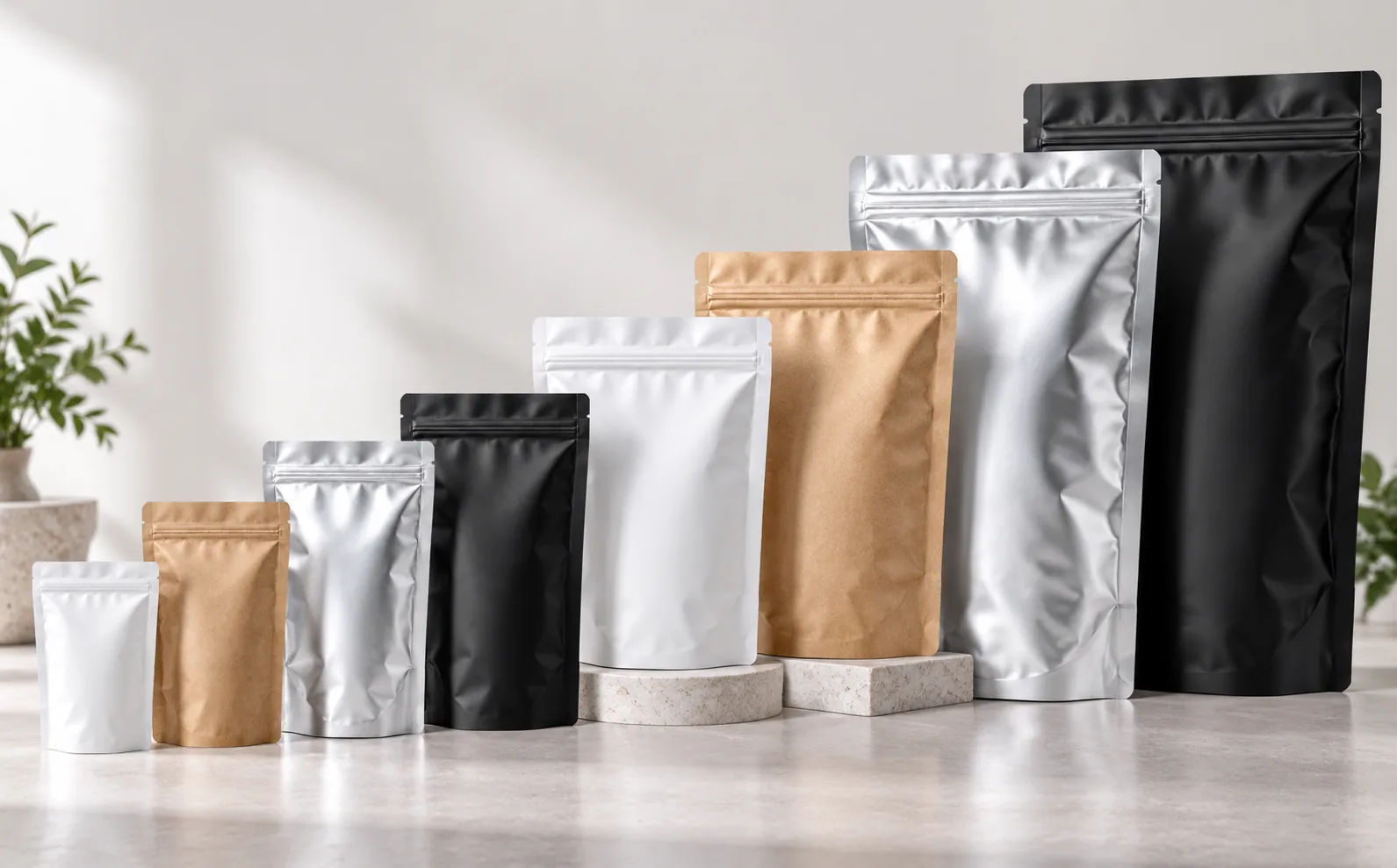
These are common finished sizes with the fill weight they typically hold, assuming a bulk density near 0.5 g/cm³ — roughly what ground coffee, most snack mixes and many powders sit at. Width × height × bottom gusset, in millimetres.
- 100 × 150 × 40 mm — about 50 g. Sample packs, single servings, tea.
- 130 × 200 × 60 mm — about 150 g. Coffee half-pound, snack portions, spice blends.
- 160 × 230 × 80 mm — about 250 g. The most ordered coffee bag size in this catalogue.
- 190 × 280 × 90 mm — about 500 g. Protein sachets, nuts, dried fruit, pet treats.
- 220 × 330 × 110 mm — about 1 kg. Bulk coffee, flour, rice, powder tubs replaced by pouches.
- 280 × 420 × 120 mm — about 2.5 kg. Catering packs, pet food, wholesale ingredients.
- 340 × 500 × 140 mm — about 5 kg. Large pet food, bulk powder, food service.
Read these as a starting point for a conversation, not as a specification. Send the product and the fill weight and we will work back to the size properly.
Bulk density is what moves the chart
Bulk density is mass divided by the volume the product occupies loose, including the air between the pieces. It varies more than people expect. Puffed snacks sit around 0.1 to 0.2 g/cm³, so a 100 g bag of crisps is physically enormous. Coffee beans are near 0.4; ground coffee near 0.5; flour around 0.55; granulated sugar around 0.85; salt near 1.2.
The arithmetic is simple: volume needed in cm³ equals fill weight in grams divided by bulk density. A 500 g fill at 0.5 g/cm³ needs 1,000 cm³ of product volume. The pouch then has to be larger than that, for the reasons below.
Three things the chart does not include
Headspace. A pouch filled to the brim cannot be sealed — the seal area has to be clear of product, and a machine needs room to form the seal cleanly. Allow 15 to 25 per cent above the product volume as a working figure. Coffee needs more, because the pack also has to accommodate the gas a valve is letting out.
The fill line, not the pouch height. The usable height is the finished height minus the top seal and minus the headspace, and on a gusseted pouch the bottom gusset takes some of the height as well when it opens. A 280 mm pouch does not hold 280 mm of product.
Settling. Powders settle in transit, sometimes by ten per cent or more. A pouch that looked full on the line looks half empty on a shelf, which is a complaint even when the weight is right. This is the single most common reason a size is changed after a first order.
Does the format change the size?
Yes, and by more than the dimensions suggest. A three-side-seal pouch has no gusset, so the same footprint holds noticeably less. A zipper pouch loses the zip strip and the space above it. A spout pouch loses volume around the fitment and cannot be filled to the same level. Comparing sizes across formats without accounting for that is how a pack ends up 20 per cent short.
How to get this right first time
Send us three things: the product, the fill weight, and how it is filled — by hand, on a pre-made pouch filler, or formed on your own line. If you can send a sample of the product, better again: we measure the bulk density rather than looking it up, and settling behaviour is something you can only see.
Sizes are made to order in any case, so the chart above is a way of framing the conversation rather than a menu. Send the fill weight and we will quote a size against it.
The standards behind this are public: see the FDA food-contact rules the structures are held to.
Stand-up pouch sizes in short
- Pouches are sold in millimetres and filled by weight; bulk density is the bridge, and it varies fivefold between puffed snacks and salt.
- Allow 15 to 25 per cent headspace above the product volume, and more for coffee, which is still outgassing.
- Usable height is the finished height minus the top seal, minus headspace, minus what the base gusset takes when it opens.
- Powders settle in transit by a tenth or more, which is the commonest reason a size is changed after a first order.
Key Information
Stand-up pouch sizes are quoted in millimetres and ordered by fill weight, and the two are not the same thing: the bulk density of the product moves the chart more than anything else.
- A working chart runs from 50 g to 5 kg, with the millimetre size for each fill weight.
- Bulk density is what converts a fill weight into a volume, so the same size holds very different weights of coffee and of powder.
- Headspace, gusset depth and the zipper all take volume the chart does not show.
- A pouch sized on weight alone is the most common reason a first sample does not fit.
- Format changes the usable volume: a flat-bottom pouch and a stand-up pouch of the same face size do not hold the same amount.
What size stand-up pouch do I need for 250 g of coffee?
Around 130 × 225 mm with a 70 mm gusset for whole beans, but the answer depends on bulk density — ground coffee packs denser than beans, so the same weight needs less volume.
Why does the same pouch size hold different weights?
Because the chart converts volume, not weight. Bulk density differs between products, so a size that holds 500 g of powder may hold 250 g of puffed snacks.
Does a zipper change the size I need?
Yes. A zipper takes headspace and reduces the usable volume, so a zippered pouch has to be slightly larger for the same fill.