
Cosmetic packaging where the pack is part of what is bought
In cosmetics and personal care, the pack is not a container for the product — it is a large part of the product. It also has to survive a bathroom shelf, resist the formulation inside it, and carry an ingredient list that regulators read closely. Appearance and performance are the same brief here, not competing ones.
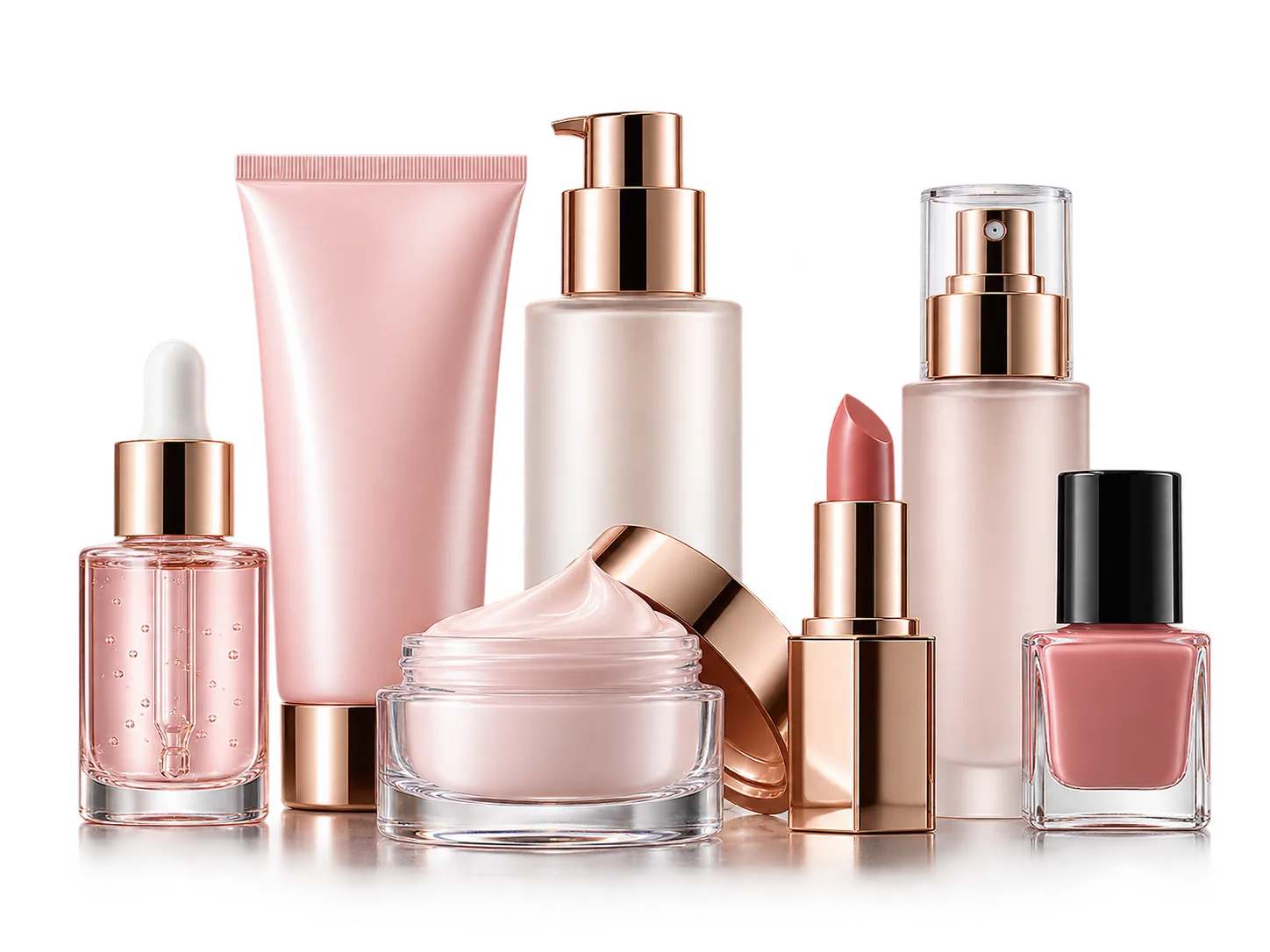
Metallic, clear and soft-touch finishes
Sachets and spout pouches for sampling and refills
Labels that hold on a wet, curved surface
Structures chosen against the formulation
What personal care asks of a pack
Four demands that are easy to under-specify.
The formulation attacks the pack
Essential oils, alcohols, acids and surfactants swell, craze or delaminate materials that would be fine with a dry powder. The structure is chosen against the formulation, and a sample of the product is worth more than a description of it.
It lives somewhere wet
A bathroom is warm, humid and full of hands. A paper label softens and lifts; an ordinary adhesive creeps. Synthetic or PET facestocks with the right adhesive are the difference between a pack that still looks new after a month and one that does not.
The finish is the positioning
Matt, gloss, soft-touch, metallic, clear-on-clear — the finish communicates the price before a word is read. These are separate passes on the line and are costed per unit, so they are decided early rather than added at the end.
Sampling and refills are their own formats
A sachet for a magazine insert, a spout pouch as a refill for a rigid bottle: both are cheap ways to put product in a customer’s hand, and both need structures specified for the formulation rather than borrowed from food.
Formats for cosmetic packaging
Primary packs, refills, samples and the labels on all of them.
Spout pouch
Refills and travel formats that pour and reclose, in puncture-resistant nylon structures.
Four side seal pouch
Sample sachets and single-use doses, flat, stiff and high barrier with an aluminium ply.
Shaped pouch
Die-cut to a brand outline, with hang holes and handles, where the silhouette is the identity.
PP bottle and cup
Creams and balms in rigid containers that seal to a foil lid and take a snap cap.
Transparent PET label
The no-label look: applied well, it reads as printed straight onto the container.
Metallic foil label
Silver or gold metallised PET, brushed or mirror, for lines that need real shine rather than metallic ink.
Structures that suit it
Barrier requirements here are usually moderate and chemical resistance is the real constraint, so the structure follows the formulation: nylon-containing laminates for oils and actives, PET/AL/PE where an ingredient oxidises, PP and HDPE for rigid packs in contact with surfactants. Finishes — matt, gloss, soft-touch, hot foil, spot UV — are covered in printing and finishing, and the label range is in labels and self-adhesive.
What has to be provable
Cosmetics carry their own regime, separate from food: ingredient lists in a defined order and nomenclature, period-after-opening marking, responsible-person details and market-specific warnings. Most of that is label content, which is the brand’s to confirm — but it constrains the pack, because a small sachet still has to carry a full ingredient list legibly. Material declarations for anything in contact with the formulation are supplied with the order. See export packaging compliance and quality and compliance.
The rules themselves are public: FDA 21 CFR 177, the US list of permitted food-contact polymers.
Questions we are asked about cosmetics and personal care
Will my formulation attack the pack?
It may. Essential oils, high alcohol content and low-pH actives all cause problems with materials that suit dry goods. Send a sample of the formulation with the enquiry and the structure is specified against it.
How do I get the no-label look?
A clear PET label on a smooth container, applied without trapped air, with the white ink block designed deliberately rather than left as a rectangle. See the transparent PET label page for what decides it.
Can I have a metallic finish without foil stamping?
Yes — a metallised PET facestock gives real specular shine across the whole label, which metallic inks approximate and do not match. Hot foil is then available on top of it for a second level of contrast.
Are refill pouches worth it?
Commercially, usually: a spout pouch ships and stores at a fraction of the weight and volume of the rigid bottle it refills, and it reads as a sustainability decision. The structure still has to suit the formulation.
Can a sample sachet carry a full ingredient list?
Yes, but legibility is the constraint rather than area. It is worth setting the artwork at final size early, because a list that does not fit changes the sachet size.
Do you supply matching primary and secondary packaging?
Yes — pouches, bottles, labels and printed cartons can be quoted together so the finishes actually match across them, which is harder to achieve across separate suppliers.
Send a sample of the formulation, not only the pack size
What is in the pack decides more than its shape does. With a sample, the shelf life and the finish you are after, we can quote a structure that will still look right in six months.
Key Information
In cosmetics and personal care the pack is a large part of what is bought. It has to carry a premium finish, survive a bathroom shelf, and resist the formulation inside it — three demands that pull in different directions.
- Appearance carries unusual weight because the pack is part of the purchase decision.
- The formulation can attack the pack from the inside, so chemical resistance is specified against the actual formula.
- Bathroom conditions mean humidity and handling with wet hands.
- Soft-touch coating, matte lamination and hot stamping are common finishes.
- Sachets and tubes are used for sampling and travel formats alongside the main pack.
What finishes are available for cosmetic packaging?
Matte and gloss lamination, soft-touch coating, hot stamping and spot varnish, with up to 10 colours in rotogravure.
Why does the formulation matter to the pack?
Because oils, alcohols and actives can attack the sealant layer from the inside. The structure is chosen against the actual formula, which is why a sample is more useful than a description.
What suits a travel or sample size?
A three or four side seal sachet, or a small tube, both of which take the same print quality as the full-size pack.