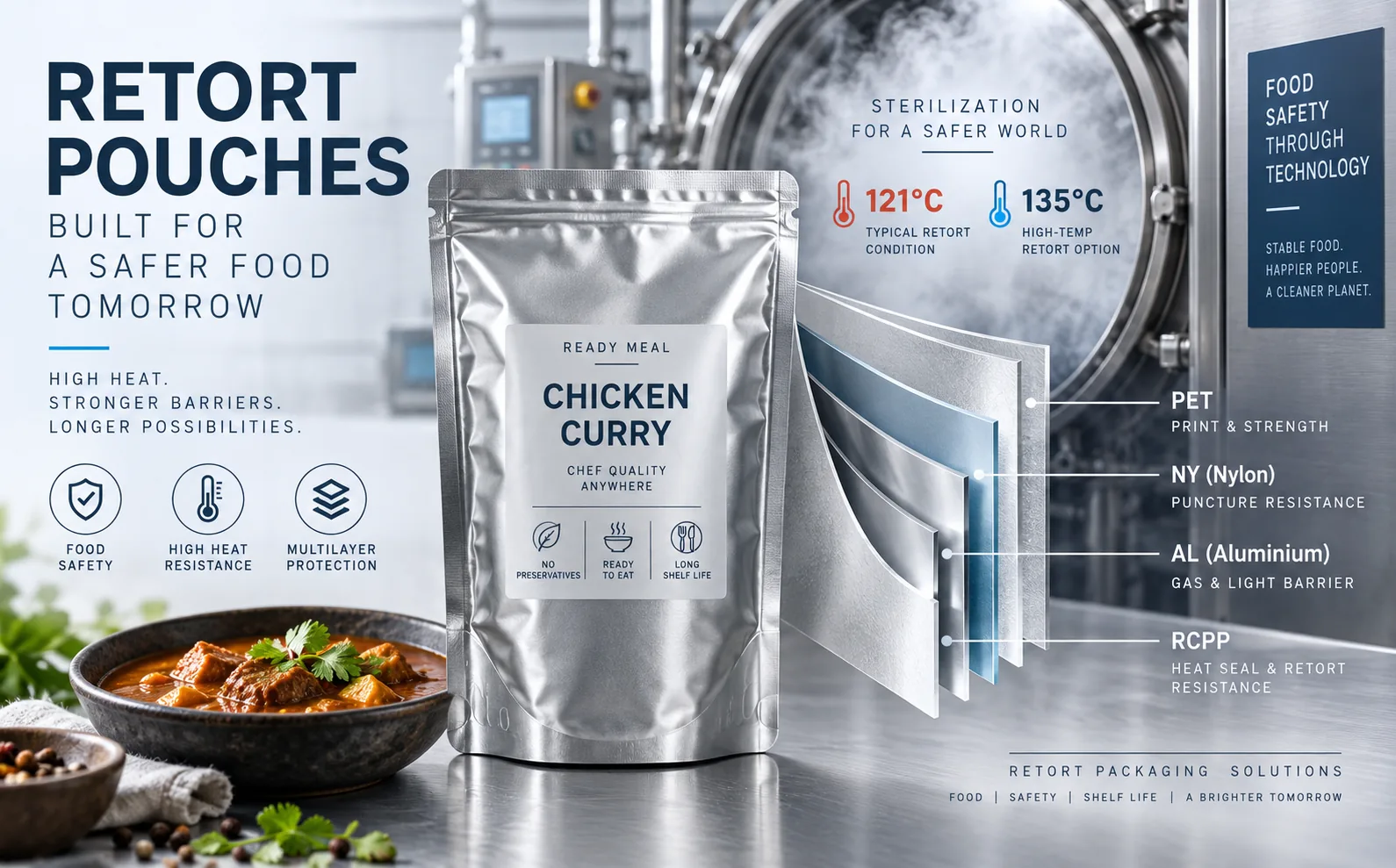
A retort pouch specification has to say which process it is for: 121 °C standard retort and 135 °C high-temperature short-time are 2 different qualifications, and passing one does not clear the other.
A retort pouch is filled, sealed, and then cooked — under pressure, hot enough and long enough to sterilise the contents commercially. What comes out is shelf stable for up to two years with no refrigeration. Almost no other flexible format survives the process, and the ones that claim to usually fail at the seal rather than in the film.
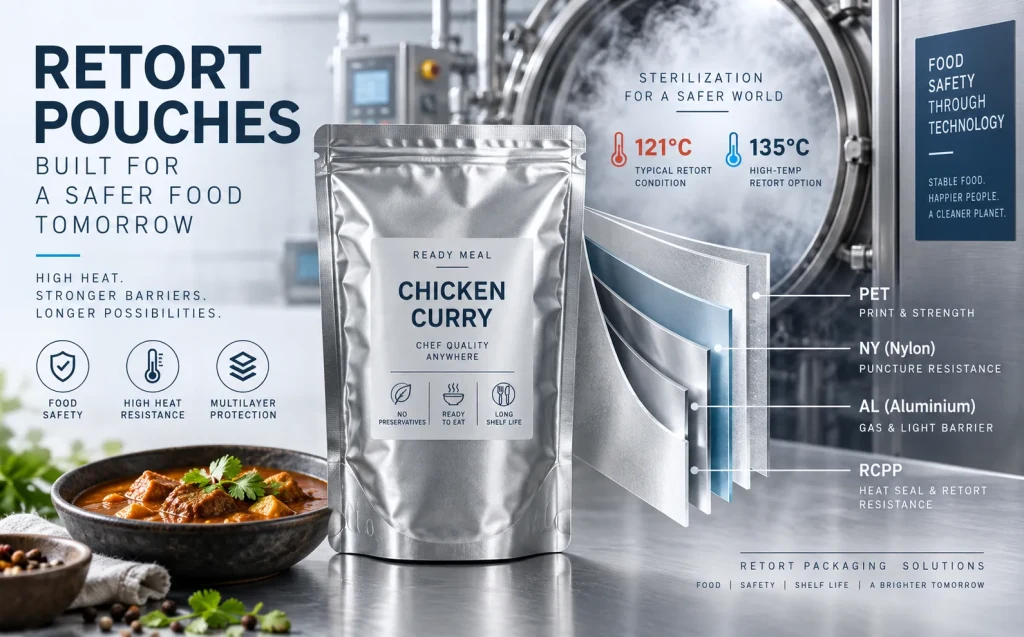
121 °C and 135 °C
Standard retort runs at 121 °C for a period determined by the food and the pack. High-temperature short-time processing runs at 135 °C for much less time, which suits products whose texture or colour suffers from a long cycle.
They are not the same specification. A structure qualified at 121 °C is not automatically safe at 135 °C: the adhesive system, the sealant grade and the seal geometry all have more to do at the higher temperature. Say which process you run before anything is quoted, because retrofitting the difference afterwards means requalifying the pack.
What the structure has to do
Four things at once, for the length of the cycle and then for two years afterwards.
- Hold together wet and hot. The adhesive between layers has to resist delamination at temperature with steam on one side and food on the other. This is where cheap retort structures fail, and it shows up weeks later as a blister between plies.
- Resist puncture. A nylon ply is standard, because the pack is handled hot and soft, then packed, shipped and stacked.
- Keep oxygen out for the claimed life. PET/NY/PE gets you the process; PET/NY/AL/PE gets you the two years. The foil ply is what makes a genuinely ambient shelf life possible.
- Seal reliably. A retort-grade CPP sealant, formulated for the temperature, with a seal width specified rather than assumed.
Seal width and fill level are part of the specification
This is the part most often left off an enquiry. Inside a retort vessel the pack is pressurised from outside and the contents expand from inside, and the difference across the seal is what tries to open it. A seal that passes a cold burst test can fail at temperature.
So the seal width, the fill level and the headspace are specified with the structure, not after it. Overfilling a pouch designed for a lower fill is one of the few ways to make a correct structure fail, and it happens on the line rather than at the converter.
What we need to quote one
The process temperature and hold time, the product and its pH and fat content, the fill weight, the shelf life, and the format — flat, stand-up or with a spout. Acidic and high-fat products behave differently against the sealant, so the food matters as much as the temperature.
Validation of your own process remains yours; what we supply is a structure specified for it, with the declarations that travel with it. See quality and compliance, and ready meal packaging for how retort compares with chilled and frozen routes.
The standards behind this are public: see FDA 21 CFR 177, which covers the polymers a retort structure is built from.
Retort pouch specification in short
- Say which process: 121 °C standard retort and 135 °C high-temperature short-time are different qualifications.
- The structure has to hold together wet and hot, resist puncture, keep oxygen out for the claimed life and seal reliably.
- PET/NY/PE gets you the process; PET/NY/AL/PE gets you the two-year ambient shelf life.
- Seal width and fill level belong in the specification, because overfilling is how a correct structure fails.
Key Information
A retort pouch specification has to name its process: 121 °C standard retort and 135 °C high-temperature short-time are two different qualifications, and passing one does not clear the other.
- 121 °C standard retort and 135 °C HTST are separate qualifications with separate structures.
- A retort pouch is filled and sealed first and cooked afterwards, under pressure.
- Seal width and fill level are part of the specification, not assembly details.
- The sealant layer has to survive the cook without delaminating or losing seal strength.
- A structure qualified at 121 °C cannot be assumed safe at 135 °C.
What is the difference between 121 °C and 135 °C retort?
They are different sterilisation processes. 121 °C is the standard cycle; 135 °C is high-temperature short-time. The higher temperature needs a structure and a sealant qualified for it, so the two are specified separately.
What structure does a retort pouch need?
Typically PET/NY/AL/PE or PET/NY/CPP, where the nylon carries the flex and puncture resistance and the sealant is chosen for the cook temperature.
Why do seal width and fill level appear in a retort specification?
Because both change how the seal behaves under pressure. An underfilled or overfilled pouch stresses the seal differently, and a narrow seal can fail during the cook.