How to choose flexible packaging materials comes down to 4 questions asked in order. Everything after that — the format, the print, the price — follows from the answers.
Most packaging decisions get made backwards. Somebody picks a pouch they liked on a shelf, then discovers the film will not run on their filling line, or that the product goes stale two months short of its stated shelf life. The structure is not a finishing touch — it is the first decision, and four questions settle almost all of it.
1. What is your product sensitive to?
Oxygen, moisture, light and aroma loss are the four things a barrier is asked to stop, and few products care equally about all four.
Roasted coffee loses aroma to oxygen within weeks. Milk powder and seasoning cake in the presence of moisture. Vitamins and fish oils degrade under light. Dried fruit and nuts mostly need moisture protection and a decent seal, and that is all.
The catalogue rates every structure from 1 to 5 for oxygen and for moisture separately, because a film can be excellent at one and ordinary at the other. A PET/PE stand-up pouch sits at 2 of 5 for oxygen — perfectly adequate for biscuits, useless for ground coffee. Add a metallised layer and PET/VMPET/PE reaches the top of the scale for both.
2. How will it be filled?
This is the question that most often gets skipped, and it is the one that stops a line.
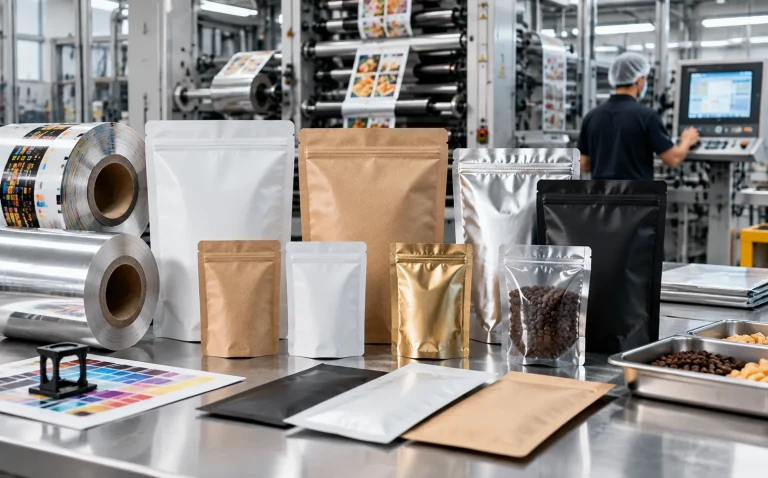
A pre-made pouch and a rollstock film are not interchangeable. Form-fill-seal machinery wants a film on a reel with the right stiffness, slip and seal-initiation temperature; a pouch filler wants a finished bag. Vacuum packing needs a structure that will not delaminate under vacuum. Retort processing at 121 °C rules out most laminates outright — only PET/NY/PE and PET/NY/AL/PE hold up.
Every product page states the processes the structure is specified for. If your machine is not on that list, say so before anything is quoted.
3. How long does it have to last?
Shelf life is where barrier turns into money. A structure with 2 of 5 oxygen barrier costs less per square metre than one at 5 of 5, and if your product turns over in six weeks the cheaper film is the right answer.
The trade only becomes obvious at the extremes. Aluminium foil blocks light, oxygen and moisture almost completely, which is why PET/AL/PE is what sensitive powders and pharmaceuticals end up in. It is also opaque, stiffer to handle, and cannot be recycled in a standard stream.
Storage conditions matter as much as the number of months. A pack destined for a Gulf warehouse in August is facing a different problem from one going to a temperate supermarket.
4. What does it have to look like?
Print surface, finish and transparency are structural choices, not decoration applied afterwards.
PET gives the best print surface and the clearest window. BOPP is glossy and cheaper. Kraft paper laminates read as natural and take print differently — softer, warmer, less saturated. A matt finish hides handling marks; a gloss finish makes colours sing under retail lighting.
If a customer has to see the product, that is a window, and a window is a hole in the barrier. Small windows on high-barrier structures are normal; a full clear face on a coffee bag is not.
Putting it together
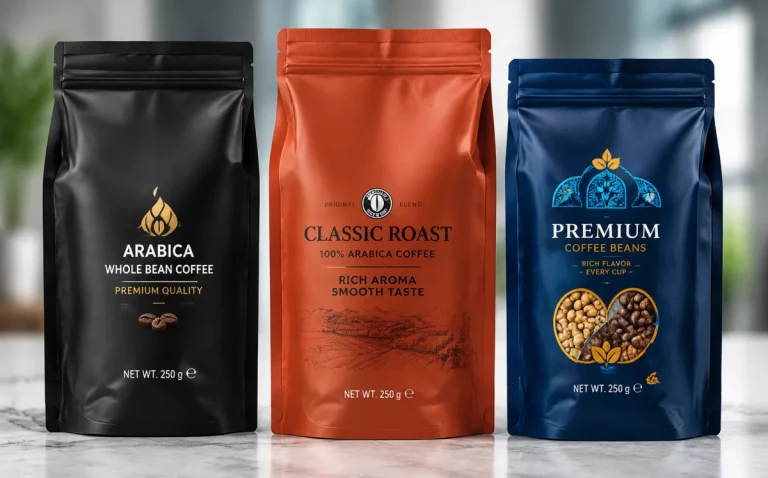
Take a real example. A roaster wants 250 g bags of whole-bean coffee, filled on a pre-made pouch machine, twelve months of shelf life, sold in a shop where the pack has to look premium.
Oxygen is the enemy, so the structure needs the top of the barrier scale. It is a pre-made pouch, so a stand-up format works. Twelve months on a roasted product means a valve, because fresh coffee outgasses and a sealed bag without one will balloon. Premium look means a matt finish and probably a kraft or dark print.
That lands on PET/VMPET/PE or PET/AL/PE, stand-up, matt, with a one-way degassing valve and a zipper. Every one of those is a listed option, and the price difference between the two structures is the conversation worth having.
What to send us
The product, the format, the quantity and the shelf life get you a real quotation rather than a range. Add the filling machine if you have one, any certification you need, and your artwork status.
If you are not sure which structure fits, describe the product and the shelf life and we will come back with two or three options and what separates them.
The standards behind this are public: see FDA 21 CFR 177, the permitted-materials list a structure has to sit inside.
Choosing flexible packaging materials in short
- Four questions, in order: what is the product sensitive to, how is it filled, how long must it last, what must it look like.
- Barrier follows the first, the sealant follows the second, the structure follows the third, the finish follows the fourth.
- A film that suits the product and not the filling machine will stop the line, so send the machine too.
- Where the market matters — FDA, GB, EU — it changes the adhesive and the ink before it changes the film.
Key Information
Choosing flexible packaging materials comes down to four questions asked in order: what the product is sensitive to, how it will be filled, how long it has to last, and what it has to look like. Format, print and price all follow from those answers.
- The four questions are asked in order because each one narrows the next; answering them backwards is the most common and most expensive mistake.
- Fill temperature and fill method decide the sealant layer before appearance is considered.
- Shelf life converts into an OTR and WVTR figure, which converts into a structure.
- Appearance is the last constraint applied, not the first.
- A pouch chosen from a shelf may not run on the buyer's own filling line.
Where should I start when choosing packaging material?
With the product, not the pack. What it is sensitive to — oxygen, moisture, light, or all three — narrows the structure faster than any other question.
Does the filling machine affect the material choice?
Directly. The fill temperature sets the sealant, and the machine sets the seal initiation temperature and the reel format, so a material that suits the product can still be unrunnable on the line.
How does shelf life become a specification?
It is converted into a required OTR and WVTR at stated conditions, and those numbers select the laminate.