
Quality and compliance
Consistent quality, verified processes and international compliance standards, so that every roll, pouch and laminate we deliver meets what was specified.
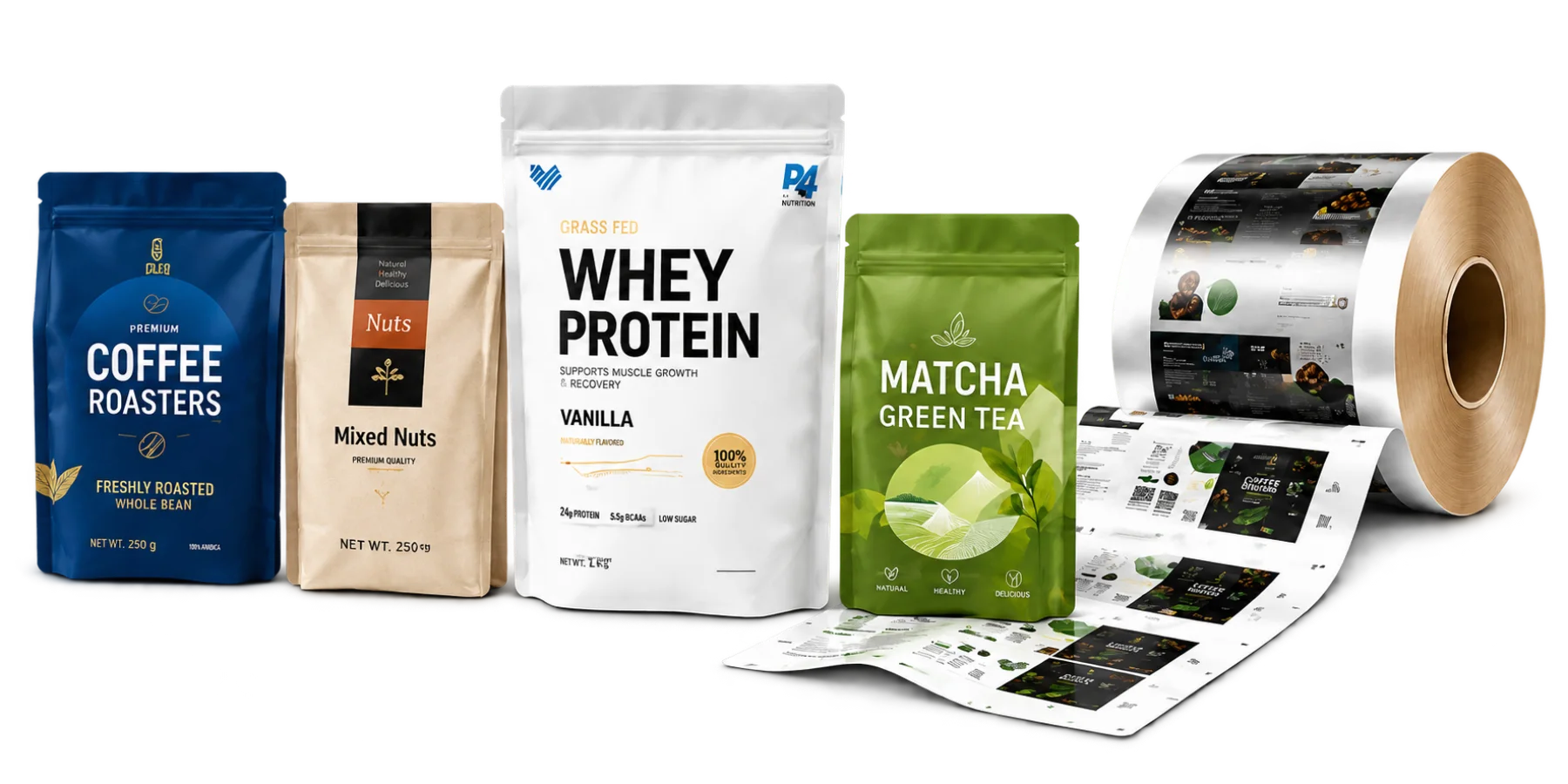
Food-grade materials
Safe, compliant materials for food, beverage and nutrition packaging.
Pre-shipment inspection
Pre-shipment inspection and dimensional checks before an order leaves.
Custom specifications
Structures, sizes and printing made to your written specification.
Export quality control
A documented export QC process for global supply chains.
Our quality process
From raw material to shipment, every step is controlled and traceable.
1
Material verification
Incoming materials inspected for compliance and certificate review.
2
Printing control
Colour management, registration accuracy and print adhesion verified.
3
Lamination
Adhesion strength, lamination integrity and mechanical performance checked.
4
Inspection
In-line and final inspection for defects, dimensions and appearance.
5
Packing
Products packed in clean, secure packaging with traceability labels.
6
Shipment review
Final documentation review and shipment approval for every order.
Standards we work to
The standards our systems and materials are held to, at the manufacturing sites we source from.
ISO 9001:2015
Quality management
BRCGS Packaging
Packaging materials
ISO 22000:2018
Food safety management
FSSC 22000
Food safety system
REACH
EC No 1907/2006
RoHS
EU Directive 2011/65/EU
Certificates are available on request. The scope of certification varies by manufacturing site, and we will tell you which site your order is made at.
Testing and performance
Products are tested for how they behave in use, not only on paper.
Barrier performance
OTR, WVTR, aroma and moisture barrier testing.
Seal integrity
Seal strength, burst and leak tests for reliable sealing.
Appearance quality
Print clarity, surface finish and visual defect control.
Consistency
Thickness, weight, COF and dimensional consistency.
Documentation and support
The documents you need for approvals and compliance. Ask and we will send the ones your order needs.
Product specification
The written specification for the structure you are buying.
Quality assurance plan
How the order is checked, at which stage, against what.
Certificate of analysis
The measured results for the batch you receive.
Material safety statement
Food-contact and material safety documentation.
What food-contact compliance actually means
Four things are being claimed when packaging is called food grade, and they are not the same claim.
The material is permitted
Every polymer, adhesive, ink and coating in a structure has to appear on the permitted list for the market the pack is sold in. The United States works from FDA 21 CFR; China from the GB 4806 series; the European Union from Regulation 1935/2004 and 10/2011. A structure that is compliant in one is not automatically compliant in another, and the difference usually sits in the adhesive or the ink rather than in the film everyone talks about.
Nothing migrates into the food
Permitted materials still have to be tested for what comes off them in use. Overall migration limits how much of anything transfers; specific migration limits named substances individually. The test conditions follow the product — an acidic sauce at 121 °C is a harder test than a dry powder at room temperature, and a certificate issued against the wrong simulant proves nothing about your pack.
The manufacturing is controlled
Good Manufacturing Practice for packaging is a systems question rather than a materials one: traceable inputs, controlled printing and lamination, defined cleaning, and a record of who made what and when. This is what BRCGS Packaging and FSSC 22000 audit, and it is why the scope of a certificate matters — it covers a site, not a company.
It can be proved on paper
A declaration of compliance names the regulation, the intended contact conditions and the party making the statement. Without those three it is a letter, not a declaration — and a customs officer or an auditor will read it as one. We issue the declaration with the order rather than after a request for it, and we say which site it covers.
Questions buyers ask before they approve a supplier
Is ALLWINS itself certified, or the factories?
The certifications named above are held by the manufacturing sites we source from, and their scope varies by site. We tell you which site your order is made at and supply that site’s certificates, rather than presenting a single company-wide claim that would not survive an audit.
Can you supply a declaration of compliance for my market?
Yes, for FDA 21 CFR and the GB 4806 series as standard, and for EU 1935/2004 and 10/2011 where the structure supports it. The declaration names the regulation, the intended contact conditions and the food types it covers. Tell us the market and the product before the order rather than after it, because the structure may need to change.
What is a certificate of analysis and when do I get one?
It is the measured result for the batch you actually received — thickness, weight, seal strength and whatever else the specification calls out — rather than a generic statement about the product. It is issued per batch and travels with the shipment.
Do you test migration, or only barrier?
Barrier and seal testing are routine on every structure. Migration testing is arranged against the specific product and contact conditions when the market requires it, because the result is only meaningful for the simulant and temperature it was run at.
What happens if a batch fails inspection?
It does not ship. Inspection happens before dispatch, at the site, against the agreed specification and quality plan. If something is out of specification you hear about it from us rather than discovering it on arrival.
Can I audit the factory myself?
Yes. Third-party audits and customer audits are both arranged, and our sourcing team coordinates them. For buyers who want the process without the travel, our global sourcing division runs inspections on your behalf.
Request specifications or compliance documents
Tell us your requirements and we will provide the specifications, certificates or test reports your project needs.
Key Information
ALLWINS quotes food-contact packaging against a named standard rather than a general assurance: FDA 21 CFR in the United States, Regulation (EC) 1935/2004 in the European Union, with declarations, migration test reports and inspection records issued with the shipment.
- Food-contact compliance is quoted against a named regulation, not against the phrase "food grade".
- United States food-contact plastics fall under FDA 21 CFR; the European Union under Regulation (EC) 1935/2004 and Regulation (EU) 10/2011.
- Migration test reports are specific to a structure and a food type, so one report does not cover a catalogue.
- Solid wood packaging is heat treated and marked to ISPM 15.
- Pre-shipment inspection is carried out as standard and the records travel with the order.
What does "food grade" actually mean?
On its own, nothing verifiable. What counts is a declaration of compliance naming the regulation, the structure and the food types it was tested against.
What documents come with an order?
A declaration of compliance for the food-contact material, migration test reports for the structure, inspection records, and the ISPM 15 mark where timber is present.
Are compliance documents issued before or after shipment?
With the shipment. A document promised afterwards is of no use at a border.